'Mr E's World': The Transatlantic Banking Corridor That Kept Epstein in Business
DOJ files show the UK's top financial enforcement officer urgently contacted US prosecutors about Epstein's JPMorgan connection three months after his death. Separately, a 2011 email shows Epstein directing JPMorgan's private bank head on market strategy. In February 2019, his assistant was still arranging premium accounts at JPMorgan for political insiders. The government's own records reveal Epstein operated not as a passive banking client but as a financial power broker across two continents.
 View source document
The Paper Trail Across Two Continents
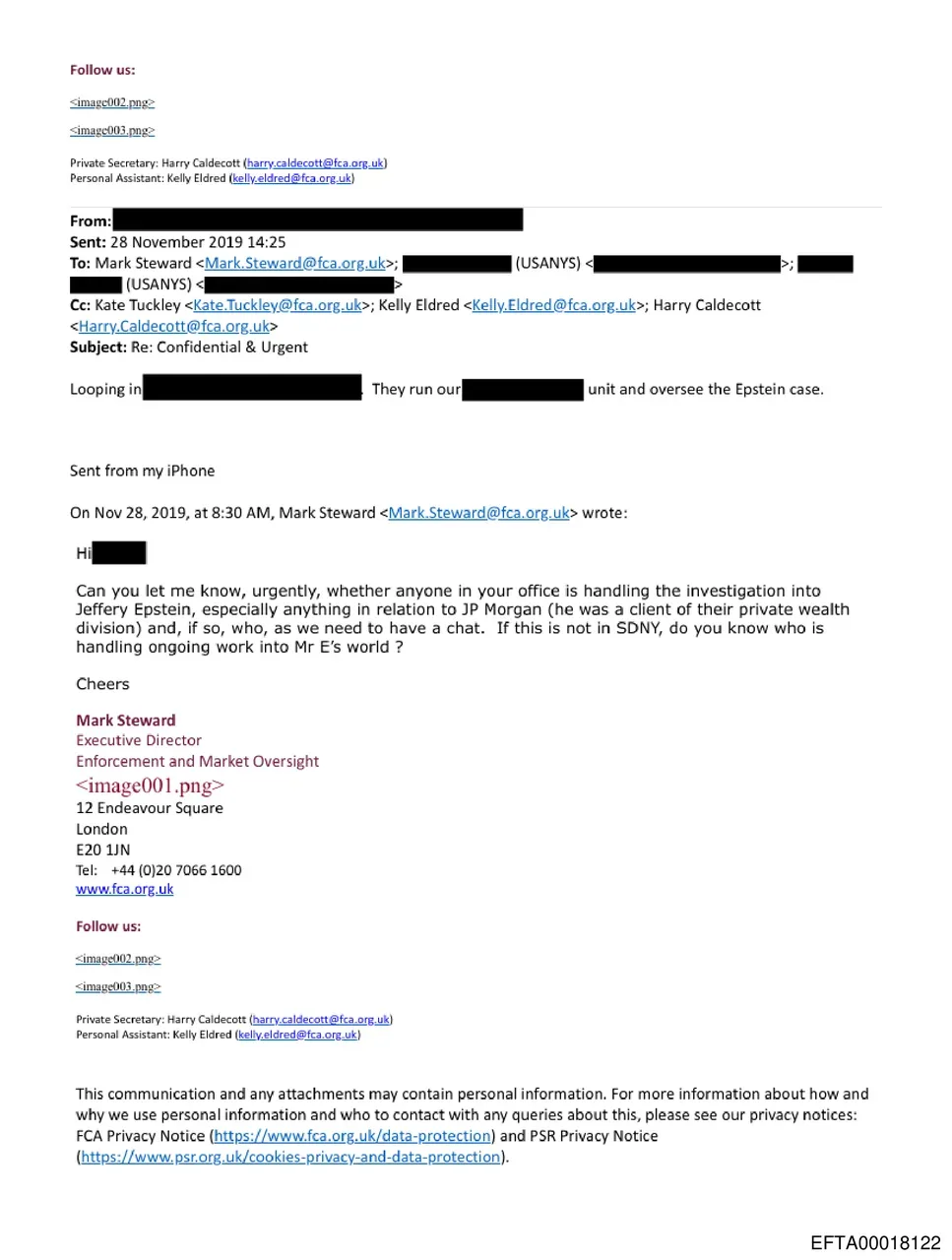
On Thanksgiving Day 2019, three months after Jeffrey Epstein's death in a Manhattan jail cell, the head of enforcement at the United Kingdom's Financial Conduct Authority sent an urgent email to the U.S. Attorney's Office in the Southern District of New York. Mark Steward, the FCA's Executive Director of Enforcement and Market Oversight, wanted to know who was handling the Epstein case — "especially anything in relation to JP Morgan (he was a client of their private wealth division)" [1]. An internal DOJ routing email identified the relevant team: "They run our unit and oversee the Epstein case" [1]. Over the next two weeks, the FCA and SDNY held multiple calls and exchanged what Steward described as "voluminous" material [1].
That exchange is one of at least five previously unreported or under-reported threads in the DOJ's Epstein File Transparency Act releases that, taken together, reveal how Epstein operated within the transatlantic banking system. A January 2011 email shows Epstein directing Jes Staley, then the head of JPMorgan's private bank, to "prepare to short the Israeli market" [2]. A February 2019 email shows Epstein's assistant contacting Mary Erdoes, CEO of JPMorgan Asset & Wealth Management, to arrange a personal account for former Obama White House Counsel Kathy Ruemmler — described as Epstein's "very good friend" [3]. Internal Deutsche Bank emails from September 2013 show three senior executives visiting Epstein's Manhattan townhouse to court him as a client after JPMorgan dropped him [4]. And a February 2019 email chain shows a firm authorized by the FCA arranging business meetings with Epstein at the same townhouse, five months before his arrest [5].
JPMorgan paid $290 million to settle claims from Epstein's victims in 2023 [6]. Deutsche Bank paid $75 million [7] and was separately fined $150 million by the New York Department of Financial Services [8]. But the government's own files reveal something the settlements didn't address: the specific mechanism by which Epstein wielded banking relationships as instruments of influence, trading premium access for political capital and maintaining operational control well beyond what any normal client would possess. These findings are based on the currently processed DOJ corpus, which continues to grow as new volumes are released.
The FCA's Thanksgiving Intervention
The email chain begins on November 28, 2019, at 8:30 AM Eastern, when Mark Steward emailed the U.S. Attorney's Office in Manhattan [1]. His message was direct: "Can you let me know, urgently, whether anyone in your office is handling the investigation into Jeffery Epstein, especially anything in relation to JP Morgan (he was a client of their private wealth division) and, if so, who, as we need to have a chat. If this is not in SDNY, do you know who is handling ongoing work into Mr E's world?" [1]
The phrase "Mr E's world" — a shorthand for the full scope of Epstein's financial operations — suggests Steward understood the investigation extended beyond any single institution. A DOJ attorney responded from an iPhone, asking if the conversation could wait until Monday. Kate Tuckley, Steward's colleague at the FCA, replied: "It is quite urgent so if we could speak then it would be greatly appreciated" [1]. They spoke that afternoon. An internal DOJ forwarding email routed the request to the team overseeing the Epstein case [1].
Over the following week, the FCA and SDNY scheduled multiple follow-up calls. On December 3, Steward wrote: "We've only received the additional material today; it is voluminous which means we won't be in a position for any meaningful conversation tomorrow. I suspect not before Friday either" [1]. The FCA — a regulatory body responsible for overseeing financial firms operating in the United Kingdom — had received a large set of materials from American prosecutors and needed days to review them. What those materials contained, what the FCA was investigating on its side, and what came of this coordination has not been publicly reported [9].
The timing is significant. In November 2021, Jes Staley resigned as CEO of Barclays after the FCA investigated his relationship with Epstein [10]. In 2025, the FCA permanently banned Staley from the UK financial services industry [11]. Bloomberg reported in March 2025 that JPMorgan told the FCA it suspected Staley was involved in Epstein's crimes [9]. The November 2019 emails show that the FCA's interest in the Epstein-banking nexus predates all of that — and that its initial focus was on JPMorgan's private wealth division, not Barclays.
 View source document
"Can you let me know, urgently, whether anyone in your office is handling the investigation into Jeffery Epstein, especially anything in relation to JP Morgan (he was a client of their private wealth division) and, if so, who, as we need to have a chat. If this is not in SDNY, do you know who is handling ongoing work into Mr E's world?" — Mark Steward, Executive Director of Enforcement, UK Financial Conduct Authority, November 28, 2019 [1]
'Short the Israeli Market': Epstein as Trading Strategist
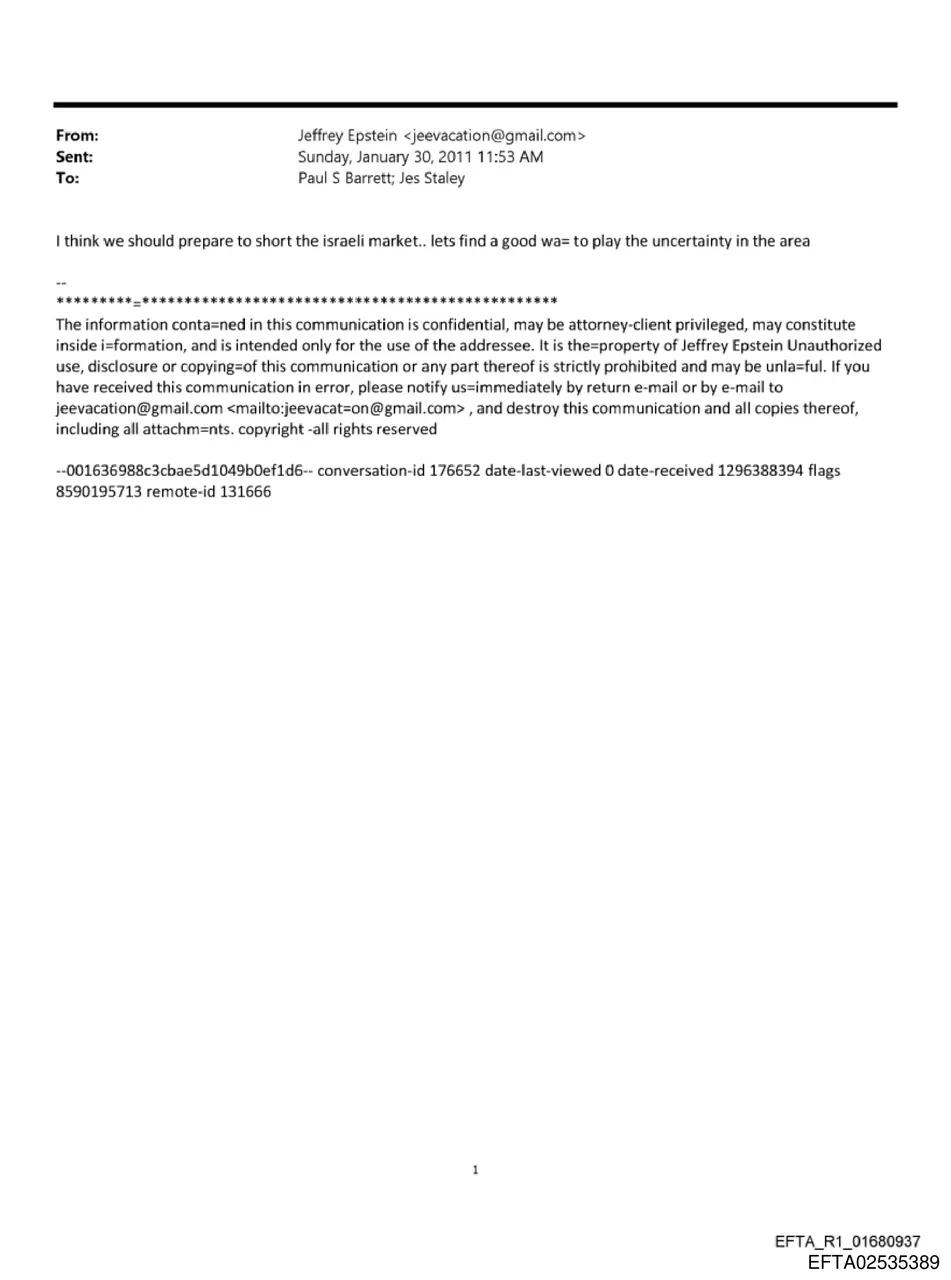
The FCA's interest in Epstein's banking relationships is easier to understand in light of what those relationships actually looked like from the inside. On January 30, 2011, Epstein sent an email from his personal account (jeevacation@gmail.com) to two recipients: Paul S. Barrett, a JPMorgan Private Bank executive, and Jes Staley, who at the time ran JPMorgan's entire private banking operation [2].
The message was one line: "I think we should prepare to short the Israeli market.. lets find a good way to play the uncertainty in the area" [2].
The date matters. On January 30, 2011, the Arab Spring was entering its most volatile phase. Hosni Mubarak's government was collapsing in Egypt; protests were spreading across the region. Epstein — a registered sex offender with no known license or credential in securities trading — was instructing the head of one of the world's largest private banks to position against a specific market based on geopolitical conditions. The email's confidentiality footer claimed it "may constitute inside information" and asserted "attorney-client privilege" [2].
Epstein was not a passive client receiving investment advice. He was issuing direction. And the recipients — the head of JPMorgan's private bank and a senior private banking executive — were addressed as peers, not service providers. Other emails from the same period show Epstein and Staley exchanging messages almost daily, coordinating meetings, and arranging Staley's visits to Epstein's British Virgin Islands property [12][13]. The relationship was a two-way operational channel, not a bank-client dynamic.
Staley left JPMorgan in 2013 and became CEO of Barclays in December 2015. He resigned in November 2021 after the FCA investigated the extent of his relationship with Epstein [10]. The FCA found that Staley had "misled" the regulator about the nature and duration of that relationship [11].
 View source document
A registered sex offender with no securities license was emailing the head of JPMorgan's private bank to direct trades based on geopolitical intelligence. The bank's own confidentiality footer on the email claimed the contents "may constitute inside information" [2].
The Validator Pipeline: Banking Access for Political Capital
If the Staley emails show how Epstein exercised influence upward — directing senior bankers on market strategy — a different set of documents shows how he exercised it outward, using banking access as currency to cultivate political insiders.
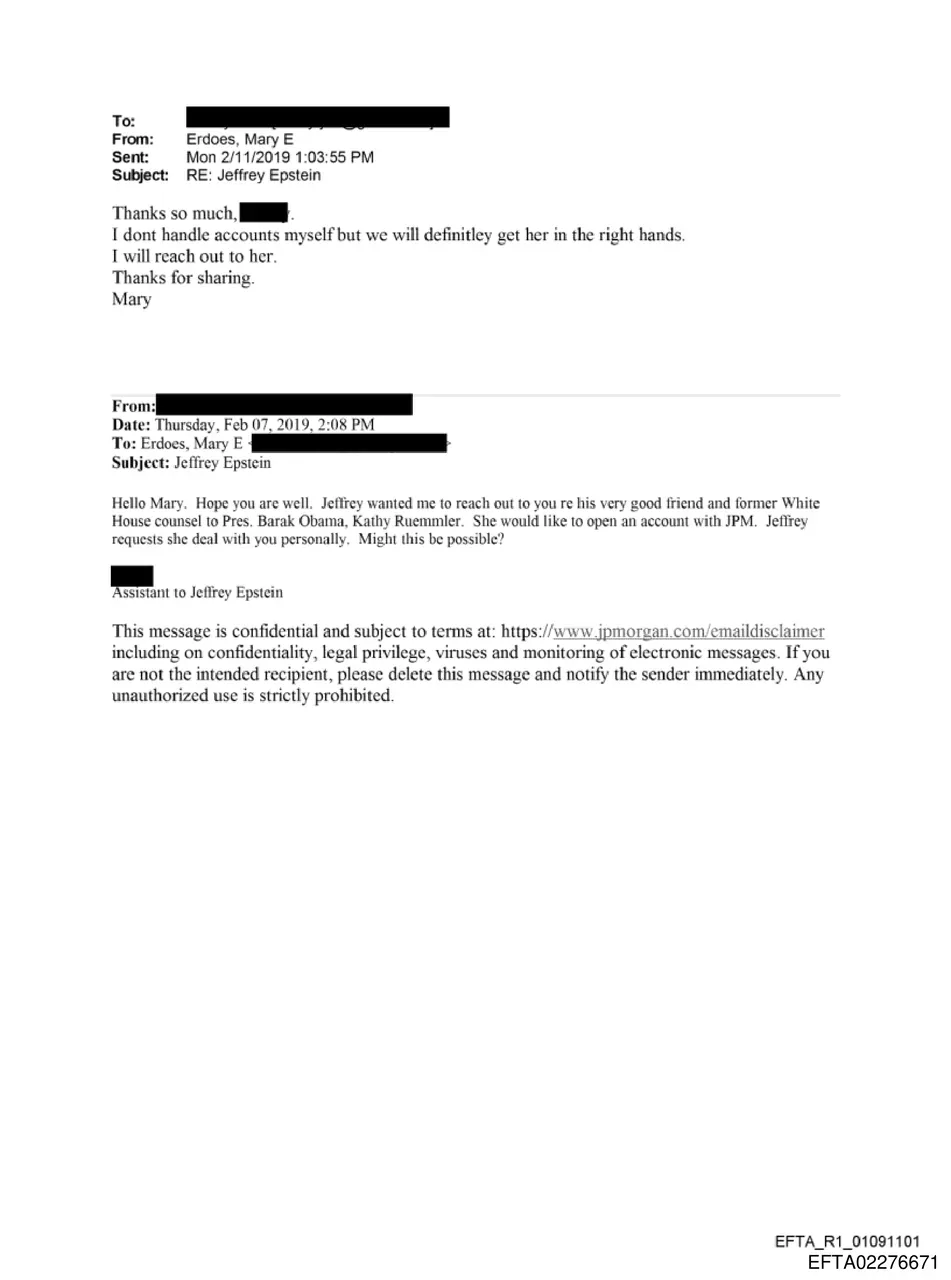
On February 7, 2019, an assistant to Epstein emailed Mary Erdoes, CEO of JPMorgan Asset & Wealth Management — the division responsible for managing over $3 trillion in client assets. The subject line was "Jeffrey Epstein." The message read: "Jeffrey wanted me to reach out to you re his very good friend and former White House counsel to Pres. Barak Obama, Kathy Ruemmler. She would like to open an account with JPM. Jeffrey requests she deal with you personally. Might this be possible?" [3]
Erdoes replied on February 11: "I dont handle accounts myself but we will definitley get her in the right hands. I will reach out to her" [3]. A convicted sex offender's request to the CEO of JPMorgan's wealth management arm — to personally arrange an account for a former White House counsel — was accommodated without apparent friction.
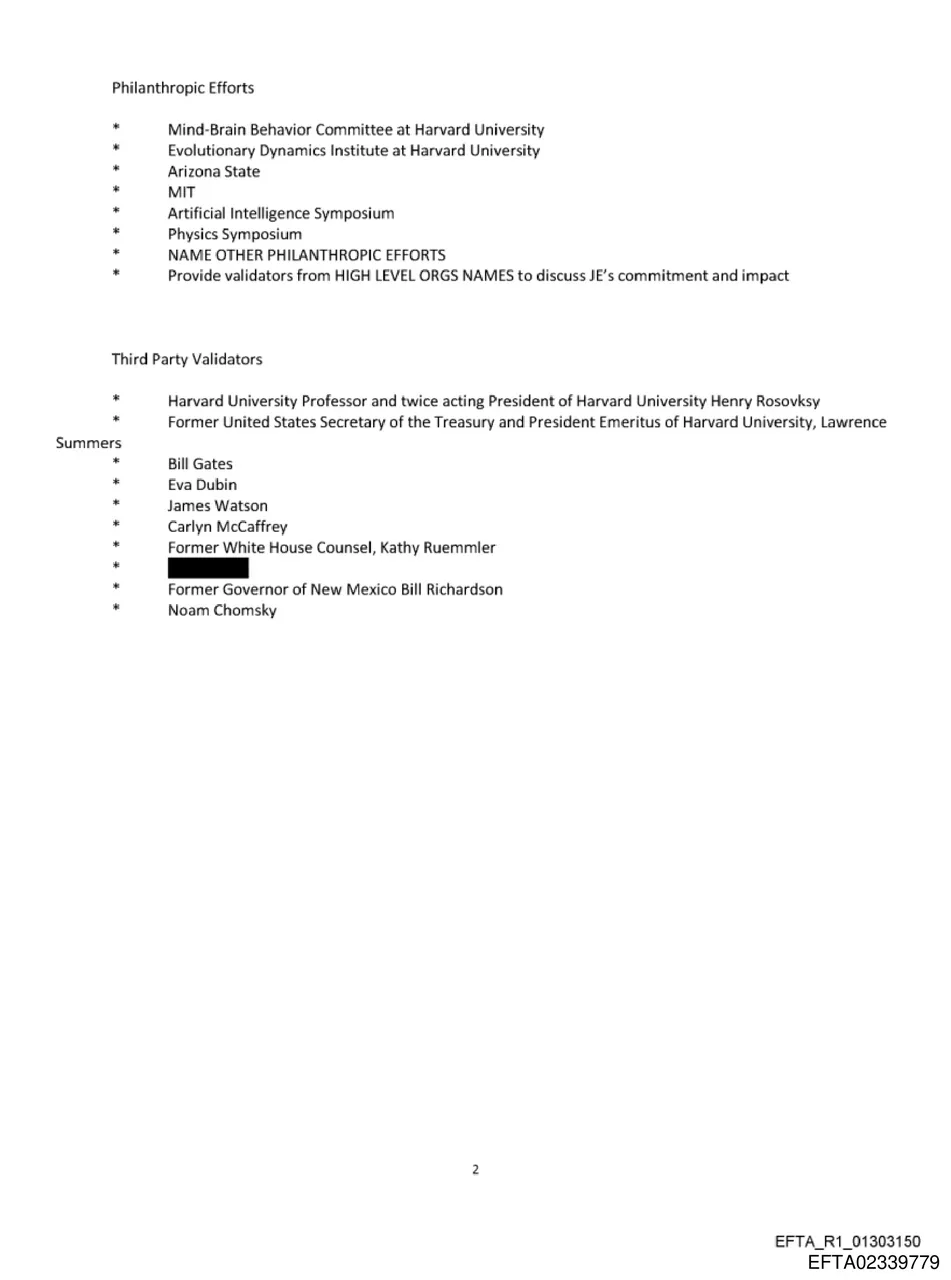
This finding gains weight when connected to a document from eighteen months earlier. In August 2017, Matthew Hiltzik — a crisis PR strategist who had been retained by Epstein at $25,000 per month [14] — sent Epstein a memo outlining a reputation rehabilitation strategy. The memo included a section titled "Third Party Validators" listing prominent individuals who could vouch for Epstein's character. The list included Lawrence Summers (former Treasury Secretary), Bill Gates, Bill Richardson (former Governor of New Mexico), Noam Chomsky, and Kathy Ruemmler [15].
Ruemmler was not merely a name on a PR list. Epstein was actively providing her with premium financial services through his own banking connections. She later joined Goldman Sachs as Global Head of Regulatory Affairs in 2020, was promoted to Chief Legal Officer in 2021, and resigned in February 2026 after DOJ files revealed the depth of her relationship with Epstein — including emails in which she addressed him as "sweetie" in March 2019 [16].
 View source document
 View source document
"Jeffrey wanted me to reach out to you re his very good friend and former White House counsel to Pres. Barak Obama, Kathy Ruemmler. She would like to open an account with JPM. Jeffrey requests she deal with you personally." — Email from Epstein's assistant to Mary Erdoes, CEO of JPMorgan Asset & Wealth Management, February 7, 2019 [3]
Deutsche Bank Comes to the Mansion
When JPMorgan finally exited its relationship with Epstein in 2013, Deutsche Bank was ready to step in. The transition was not accidental. Paul Morris, a Managing Director at Deutsche Bank Asset & Wealth Management, had previously managed Epstein's account at JPMorgan before moving to Deutsche Bank in late 2012. Morris projected that Epstein could bring $100 to $300 million in account flows and $2 to $4 million in annual fees [17].
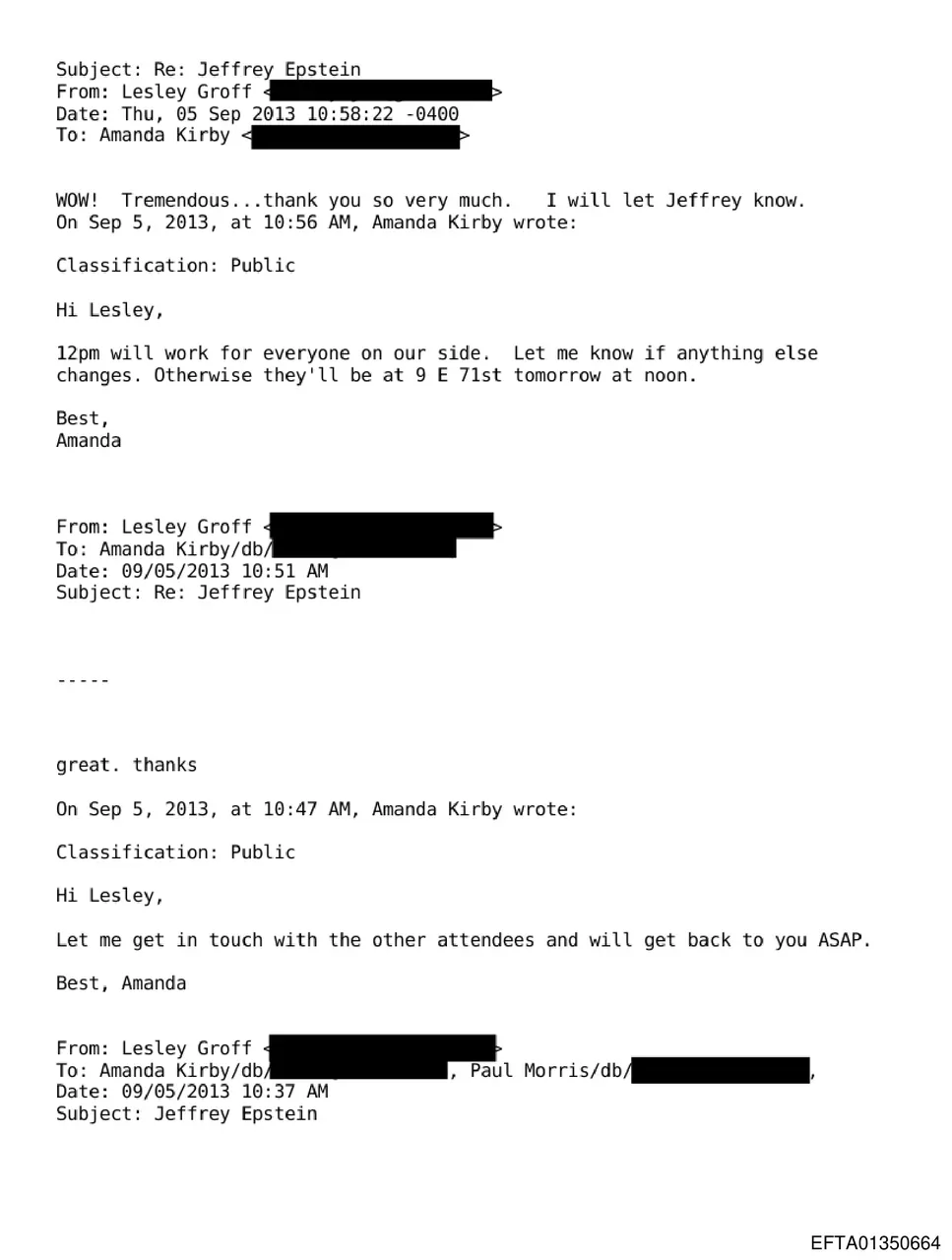
Internal Deutsche Bank emails from September 2013, released under the File Transparency Act, show the onboarding in action. On September 5, 2013, Lesley Groff — Epstein's longtime personal assistant — emailed Amanda Kirby at Deutsche Bank to schedule a meeting at Epstein's residence at 9 East 71st Street, between Fifth Avenue and Madison Avenue. Kirby confirmed that Morris would be bringing two senior colleagues: Caroline Kitidis, Head of the Key Clients Partners Group, and Tazia Smith, a Director in that group [4]. When Groff asked to move the meeting from 10 AM to noon, Kirby responded: "12pm will work for everyone on our side. Let me know if anything else changes. Otherwise they'll be at 9 E 71st tomorrow at noon" [4]. Groff's reply: "WOW! Tremendous...thank you so very much. I will let Jeffrey know" [4].
Three senior Deutsche Bank executives — including the Head of Key Clients — went to a convicted sex offender's townhouse to court his business. The NYDFS consent order, issued when the regulator fined Deutsche Bank $150 million in July 2020, noted that onboarding was approved based on "an undocumented meeting between Epstein and two front office staff" [8]. Whether this September 2013 meeting is the one referenced in the consent order is unclear, but the timing aligns with the August 2013 account opening. Tazia Smith's name does not appear in any public reporting on the Deutsche Bank-Epstein relationship. Deutsche Bank went on to open more than 40 accounts for Epstein over the next five years [8].
 View source document
An FCA-Authorized Firm at 9 East 71st Street
The Deutsche Bank meetings at Epstein's townhouse were not an isolated event. In February 2019, a separate set of emails shows another financial firm arranging in-person meetings with Epstein at the same address.
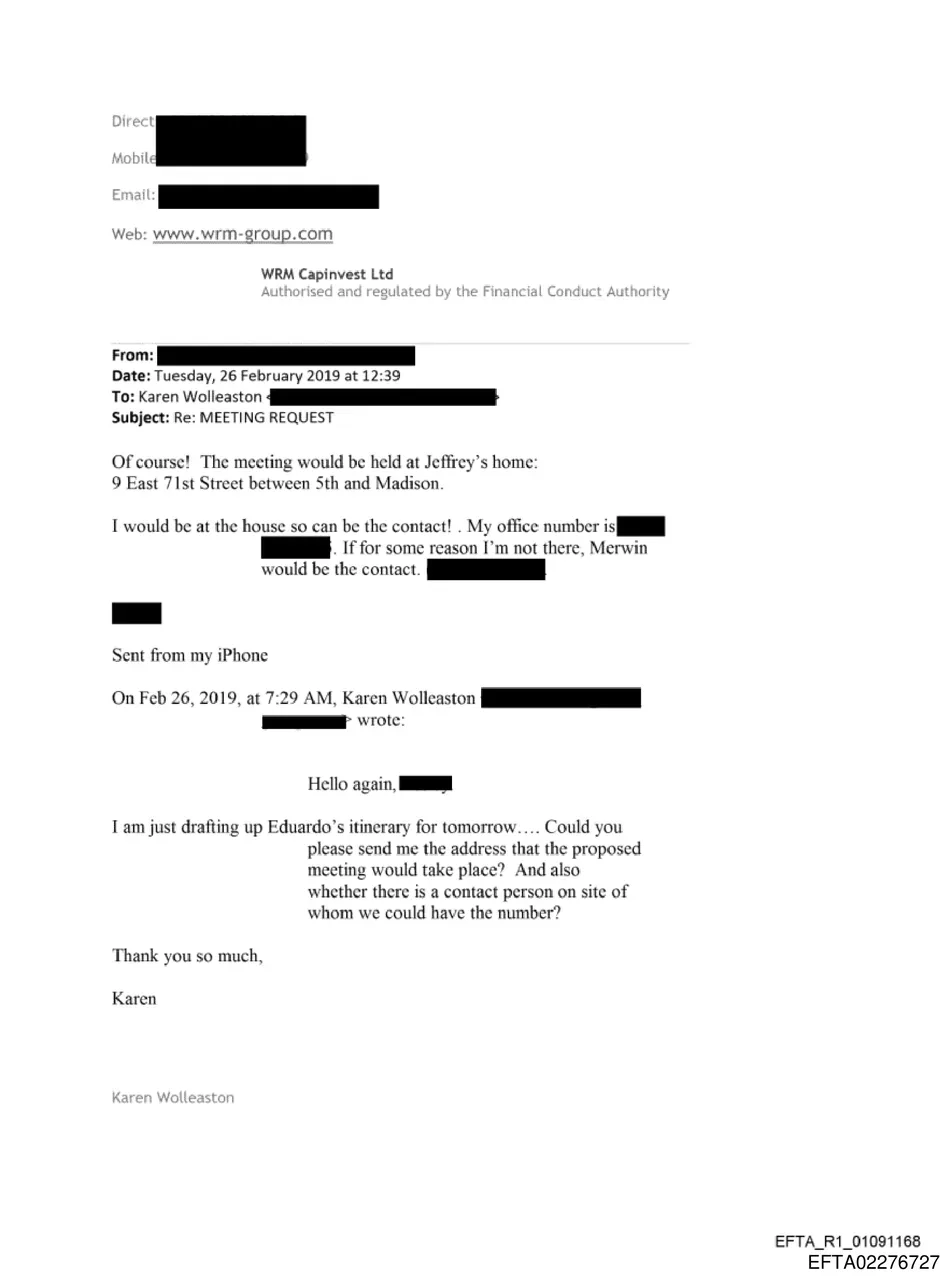
Karen Wolleaston of WRM Group — described in email disclaimers as a firm "authorised and regulated by the Financial Conduct Authority" — coordinated meetings between individuals named Eduardo and Paolo and Jeffrey Epstein at 9 East 71st Street on February 26 and 28, 2019 [5]. Lesley Groff handled scheduling on Epstein's end, confirming: "Jeffrey is in NY and can see Eduardo and Paolo" [5]. Groff provided the address: "9 East 71st Street between 5th and Madison" [5].
These meetings occurred five months before Epstein's arrest on July 6, 2019. They occurred nine months before the FCA's Mark Steward contacted SDNY about the Epstein-JPMorgan connection. The nature of the business discussed at these meetings is not stated in the documents. But the fact that a firm regulated by the FCA was actively conducting business with Epstein at his residence in 2019 raises an unanswered question: when the FCA later investigated Epstein's banking relationships, did it examine firms under its own regulatory umbrella that had been transacting with him? No public reporting has connected WRM Group to Epstein [5].
In the currently processed DOJ corpus, no additional documents referencing WRM Group or Karen Wolleaston have been identified. Additional unprocessed documents may add context.
 View source document
Between 2011 and 2019, Epstein directed trades at JPMorgan, arranged premium accounts for political insiders through its CEO, hosted Deutsche Bank executives at his mansion, and conducted business with an FCA-regulated firm — all while registered as a sex offender. The banking system did not fail to detect him. It served him.
What the Documents Don't Tell Us
These files establish a pattern, but they leave critical questions unanswered. The FCA-SDNY email chain shows urgent cross-border coordination but does not reveal what the FCA was investigating in its own jurisdiction, what the "voluminous" materials contained, or what enforcement actions — if any — resulted specifically from this exchange [1]. The Steward emails are from DOJ Data Set 8; additional FCA-related documents may exist in volumes not yet processed through the ranking pipeline.
The Epstein-Staley trading email is a single communication. It does not establish whether any trades were executed, whether Staley or Barrett acted on the instruction, or whether the suggestion amounted to anything beyond an email that went nowhere [2]. Staley's representatives have previously stated that his relationship with Epstein was a "professional mistake" [10].
The Ruemmler-Erdoes email shows a referral, not a completed account opening. It does not confirm whether Ruemmler ultimately opened the account or what terms it carried [3]. Ruemmler has not been accused of wrongdoing in connection with Epstein's crimes.
The Deutsche Bank meeting emails confirm a visit to Epstein's residence but do not detail what was discussed or decided [4]. The WRM Group emails confirm scheduled meetings but not their substance [5].
What these documents do establish, collectively, is the infrastructure: a convicted sex offender who maintained the ability to direct market strategy to the head of one of the world's largest private banks, arrange premium accounts for political insiders through the bank's CEO, attract senior Deutsche Bank executives to his home for client meetings, and conduct business with firms regulated by the very authority that would later investigate his financial network. That infrastructure was still operational in February 2019. The files linked below are the government's own records. Read them.
Frequently Asked Questions
- Did Epstein have accounts at JPMorgan after his conviction?
- Yes. DOJ records show Epstein maintained active banking relationships with JPMorgan through at least February 2019, when his assistant was still arranging premium accounts through the bank's CEO Mary Erdoes. JPMorgan paid $290 million to settle claims from Epstein's victims in 2023.
- What did the UK Financial Conduct Authority investigate about Epstein and JPMorgan?
- On Thanksgiving Day 2019, the FCA's head of enforcement urgently contacted SDNY prosecutors about Epstein's JPMorgan connection. The FCA received 'voluminous' materials from American prosecutors and held multiple follow-up calls. The FCA later permanently banned Jes Staley from UK financial services.
- How much did Deutsche Bank pay in fines related to Epstein?
- Deutsche Bank paid $75 million to settle claims from Epstein's victims and was separately fined $150 million by the New York Department of Financial Services. The bank opened more than 40 accounts for Epstein after JPMorgan dropped him in 2013.
- Was Epstein directing trades at JPMorgan?
- A January 2011 email shows Epstein instructing Jes Staley, then head of JPMorgan's private bank, to 'prepare to short the Israeli market' during the Arab Spring. Epstein had no known securities license. The email's own confidentiality footer stated it 'may constitute inside information.'
- Who was Kathy Ruemmler and what was her connection to Epstein?
- Kathy Ruemmler was former White House Counsel under President Obama. In February 2019, Epstein's assistant arranged a personal JPMorgan account for her through the bank's CEO. Ruemmler was also listed as a 'Third Party Validator' in Epstein's 2017 PR rehabilitation strategy. She resigned from Goldman Sachs in February 2026 after the DOJ files revealed the depth of the relationship.