DOJ File Shows Epstein and Krassner Editing Trump Allegation Wording in 2017
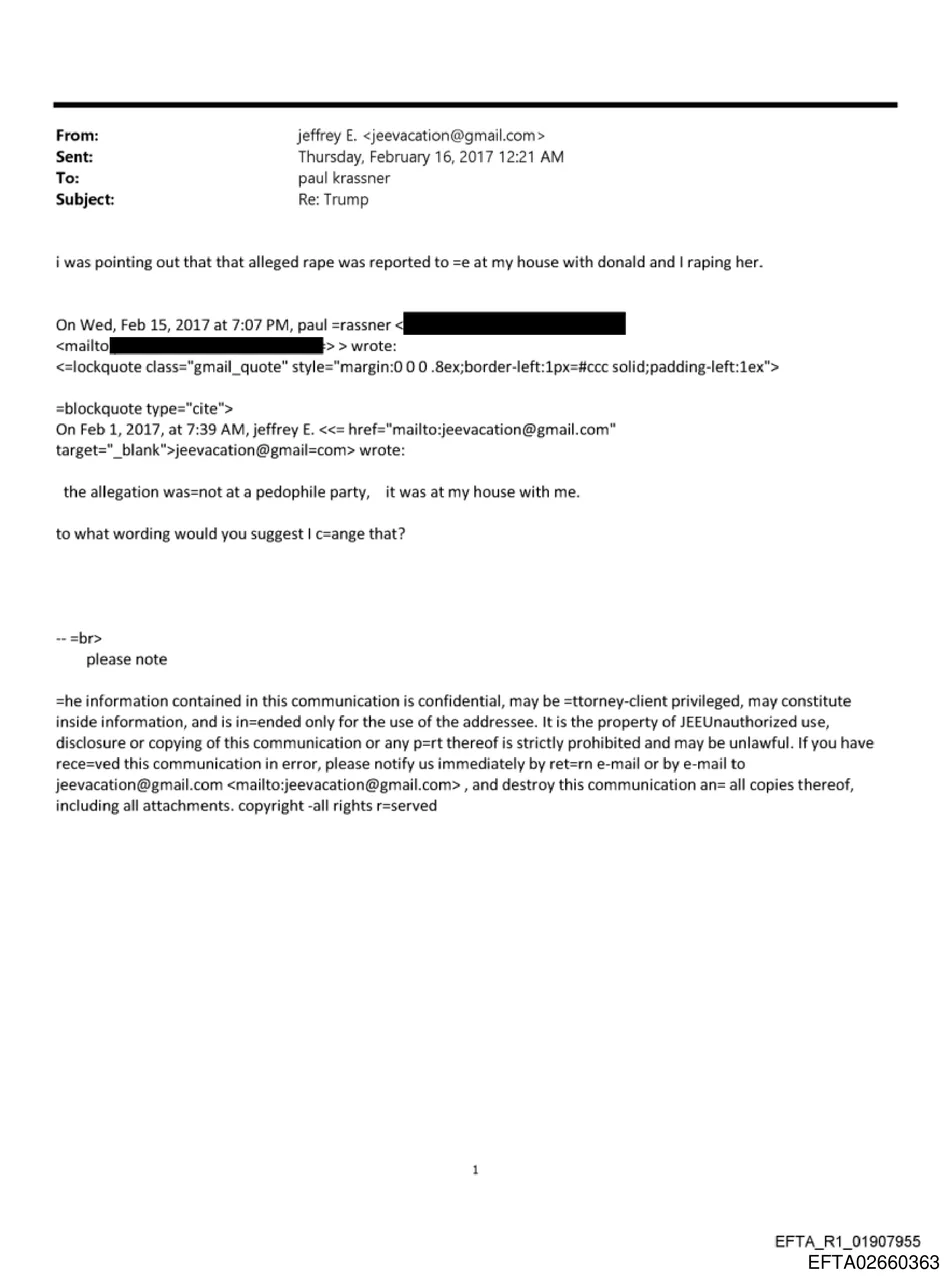
DOJ file EFTA02660363 preserves a one-page email where Jeffrey Epstein discusses wording of a rape allegation involving Donald Trump. Adjacent records show an ongoing editing thread with Paul Krassner and forwarded media coverage, not an adjudicated finding.
 View source document
What EFTA02660363 Actually Contains
EFTA02660363 is a single-page email artifact dated February 16, 2017, sent from the account labeled "jeffrey E." (jeevacation@gmail.com) to Paul Krassner [2]. The page includes this subject line, "Re: Trump," and a sentence that references an alleged rape and says it was reported "at my house" with "donald" named in the same line [2]. The same page also quotes an earlier exchange and repeats a separate phrasing: "the allegation was not at a pedophile party, it was at my house with me" [2][3]. Because the email export contains visible encoding artifacts and redactions, the most reliable reading comes from rendering and visually inspecting the original PDF page, not OCR alone [2].
A nearby record, EFTA02661107, appears to be part of the same thread family and contains the earlier February 1, 2017 wording about "not at a pedophile party" [3]. In plain terms, the core evidentiary value here is narrow but significant: the government-released file shows an email discussion in which Epstein and Krassner are actively discussing phrasing around a rape allegation involving Trump. The file is evidence of correspondence about an allegation, not a judicial finding that the allegation was proven.
View source document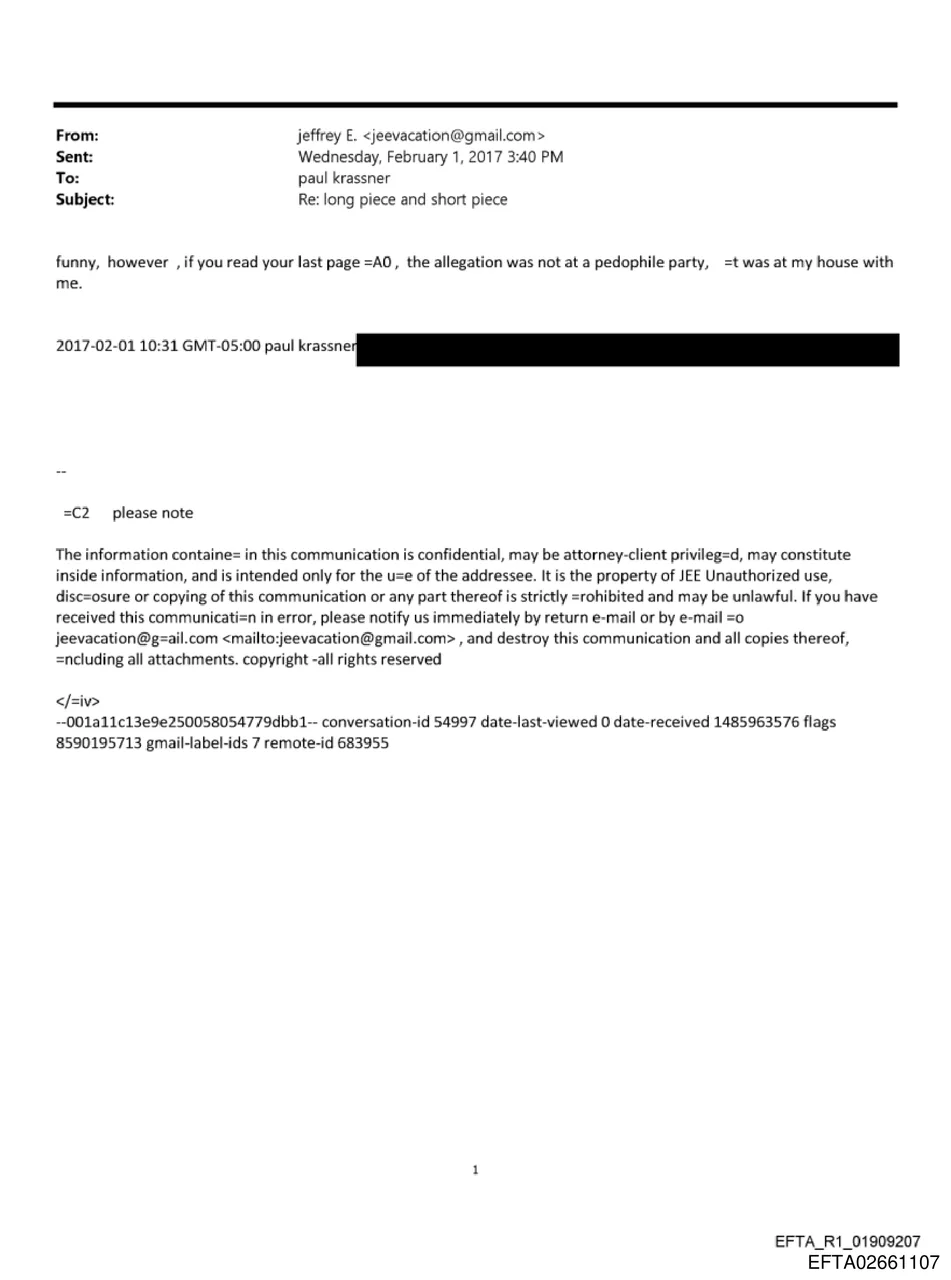 View source document
EFTA02660363 documents an allegation-discussion workflow in real time: wording edits, quote-back context, and legal-style disclaimers inside a direct Epstein-Krassner exchange. [2][3]
"the allegation was not at a pedophile party, it was at my house with me." [3]
The Surrounding Thread: Edits, References, and Forwarded Coverage
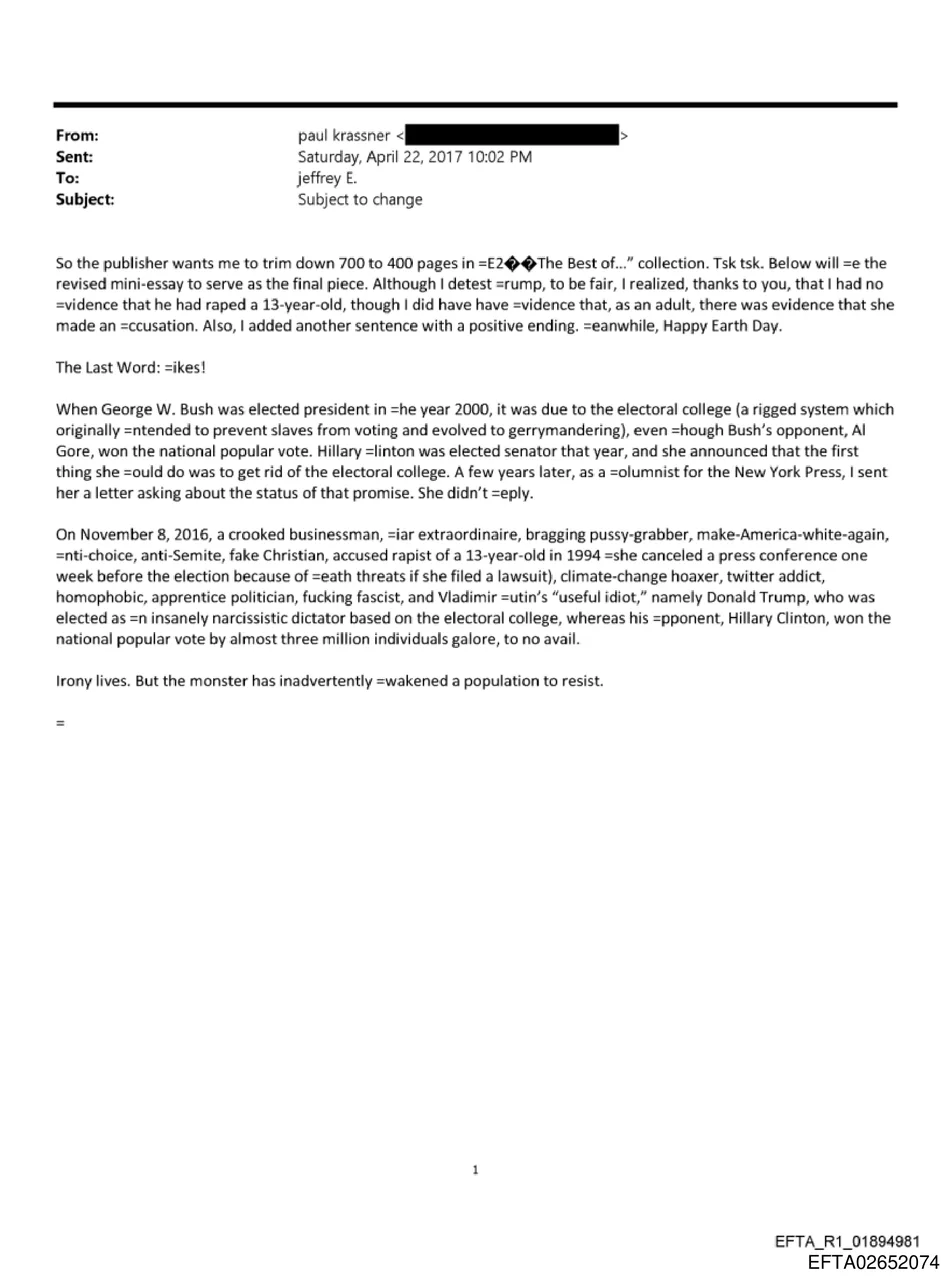
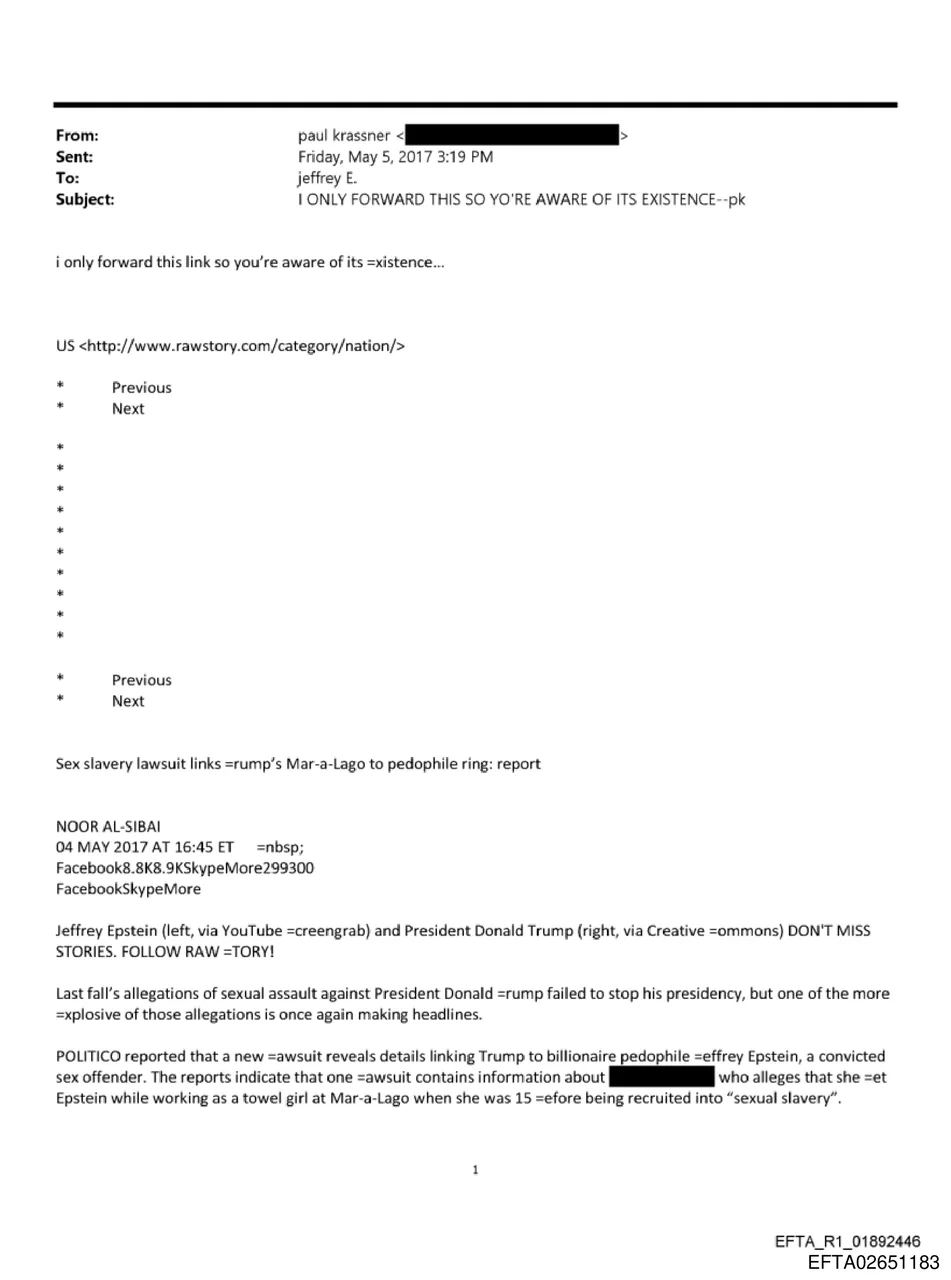
Adjacent files in the same release window show this was not a one-off page. In EFTA02652074 (April 22, 2017), Krassner writes draft language for publication and explicitly says he had "no evidence" Trump raped a 13-year-old, while still referring to the existence of an accusation [4]. One day later, EFTA02652311 shows a reply from the "jeffrey E." account discussing a Guardian article and referencing wording choices in that same draft [5]. In EFTA02651183 (May 5, 2017), Krassner forwards a Raw Story link "only" so Epstein is aware of it, extending the same allegation context into media-monitoring behavior rather than direct eyewitness corroboration [6].
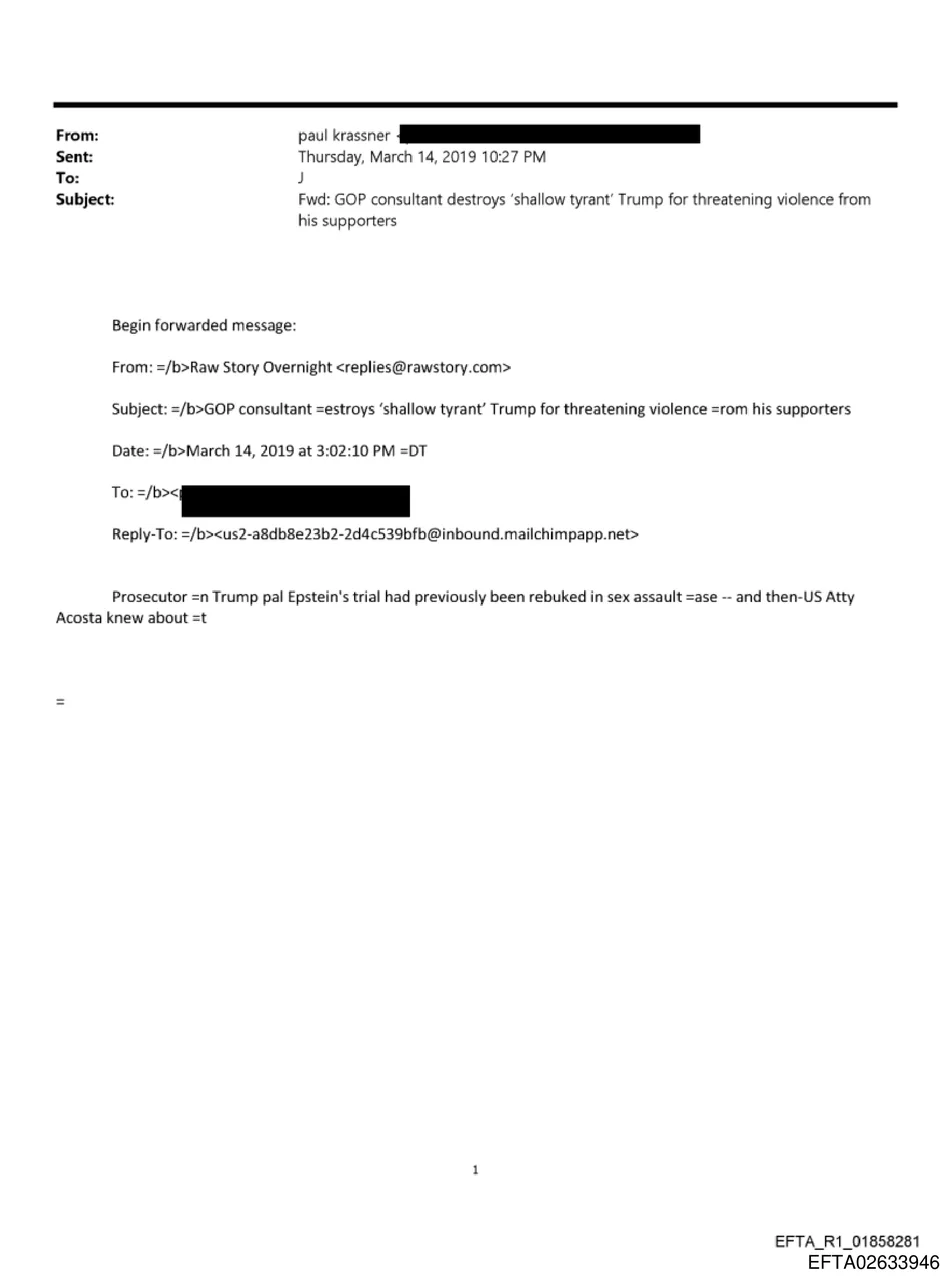
The cluster also includes politically charged forwarded-news traffic from later dates, such as EFTA02633946 in March 2019, which relays a Raw Story overnight headline [7]. And not every near-adjacent record is about allegations: EFTA02660359, sent one minute earlier than EFTA02660363, is routine correspondence about signed materials and magazine logistics [11]. EFTA02659674 and EFTA02661389 similarly show ordinary exchange content plus recurring legal-disclaimer blocks [12][13]. Taken together, the records show a mixed inbox: some allegation-related phrasing discussions, some media forwarding, and some mundane personal/editorial traffic.
 View source document
 View source document
Document Timeline
Email states: allegation was not at a 'pedophile party,' but at Epstein's house.
[3]EFTA02660363 records the key line naming 'donald' in the allegation-phrasing exchange.
[2]Krassner draft email says he had no evidence Trump raped a 13-year-old, while discussing accusation language.
[4]Reply references Guardian reporting and continued wording edits.
[5]Forwarded Raw Story article sent to Epstein for awareness.
[6]Later forwarded-news email continues political/Epstein headline traffic.
[7]What This Set Establishes and What It Cannot Establish
This subset of files establishes that allegation language involving Trump was actively discussed in Epstein-Krassner correspondence in 2017 and recirculated via media links afterward [2][3][4][5][6]. It does not, by itself, establish that the underlying allegation was proven in court. Public docket records for Jane Doe v. Trump (1:16-cv-07673, S.D.N.Y.) show the case was filed on September 30, 2016 and terminated on November 4, 2016 with a Notice of Voluntary Dismissal [8]. Contemporary reporting from November 2016 described the same case's withdrawal before the election [9].
The documents also sit inside a larger communications footprint: at least 153 DOJ FTA documents in the currently processed corpus mention Paul Krassner [1]. A separate historical reference frequently invoked in later coverage is Donald Trump's 2002 New York magazine quote about knowing Epstein and saying he liked women "on the younger side" [10]. That quote provides public-era context for why allegation-related emails were politically combustible in 2017, but it is not proof of any specific criminal event [10]. In the currently processed corpus, these files are best read as documentary evidence of allegation management and messaging behavior. Additional unprocessed volumes may add context or contradiction.
 View source document
Frequently Asked Questions
- Did Epstein email about Trump rape allegations?
- Yes. DOJ file EFTA02660363, dated February 16, 2017, preserves an email from Jeffrey Epstein to writer Paul Krassner discussing wording of a rape allegation involving Donald Trump. The email states the allegation occurred 'at my house with me.' The file is evidence of correspondence about an allegation, not a judicial finding that the allegation was proven.
- Who was Paul Krassner and what was his connection to Epstein?
- Paul Krassner was a satirist and writer. At least 153 DOJ documents in the processed corpus mention his name. The 2017 email thread shows Krassner and Epstein actively editing phrasing around a Trump allegation, with Krassner explicitly stating he had 'no evidence' Trump raped a 13-year-old while still discussing the accusation's wording.
- Was the Jane Doe v Trump Epstein lawsuit resolved?
- The lawsuit Jane Doe v. Trump (1:16-cv-07673, S.D.N.Y.) was filed on September 30, 2016 and terminated on November 4, 2016 with a Notice of Voluntary Dismissal. The case was withdrawn before the 2016 presidential election.
- What do the Epstein-Krassner emails prove about Trump?
- The emails document an allegation-discussion workflow between Epstein and Krassner in 2017, including wording edits and media monitoring. They do not, by themselves, establish that the underlying allegation was proven in court. They are evidence of correspondence about an allegation, not independent corroboration of the allegation itself.