Trump Claims "Total Exoneration." The Files Show Epstein Took The Fifth About Trump And Underage Girls.
Trump declared himself "fully exonerated" and a White House spokeswoman said he had been "totally exonerated on anything relating to Epstein." The House Oversight records tell a different story: Trump's deposition was scheduled in a Jane Doe case, Epstein took the Fifth when asked about Trump and underage socializing, the victim was recruited at Mar-a-Lago, and Maxwell — now offering clemency-era exoneration — avoided her own deposition claiming a sick mother.
 View source document
The Paper Trail Maxwell Cannot Replace
In February 2026, Donald Trump declared himself "fully exonerated" after the Justice Department released another batch of Epstein files, and a White House spokeswoman told reporters he had been "totally exonerated on anything relating to Epstein" [19]. Days earlier, lawyers for Ghislaine Maxwell said she was prepared to "speak fully" if granted clemency and publicly advanced the line that Trump "did nothing wrong" [1]. Later that month, NBC New York and the Associated Press reported that the Justice Department was reviewing Epstein-related files that had been withheld from the public release, putting Trump-linked records back at the center of the story [2]. The less-covered document trail behind that current fight is older and narrower, but it is real. In an August 11, 2009 House Oversight email chain in a "Jane Doe" matter, a paralegal at the West Palm Beach firm Burman Critton Luttier & Coleman was told that Maxwell's deposition had been reset from August 17 to September 23 and that "Mr. Trump's deposition is scheduled for August 18, 2009" [3][15]. Another message from the same afternoon says, simply, "Trump has been moved to Sept. 24" [4]. A parallel version of the same chain, preserved in a separate batch of oversight records, confirms the identical scheduling details [14].
Trump's name currently appears in 3,913 processed House Oversight records and 2,617 processed DOJ FTA records in the local corpus [10][11]. Many of those are duplicates, media clippings, or incidental mentions. The smaller set reviewed for this article is the one that matters: formal deposition scheduling, a lawyer's sworn affidavit explaining why Trump was pursued, an earlier deposition in which Epstein took the Fifth when asked about Trump and underage socializing, and a victim account connecting the litigation directly to Mar-a-Lago [3][4][5][12][13][16]. If Maxwell is now offering Trump an exculpatory narrative as part of a clemency push, the oversight files show Trump's name was already inside the formal discovery calendar of victim litigation in 2009 — and that the same litigation generated evidence Maxwell's 2026 pitch does not address. [1][3][4][12][13]
 View source document
 View source document
Trump claims "total exoneration." Maxwell offers to confirm it for clemency. The 2009 oversight emails show Trump was already on the witness calendar in Epstein victim litigation — in a case where Epstein refused to answer whether Trump had socialized with underage females. [19][1][3][4][13]
What The Record Shows
On February 9, 2026, Maxwell's lawyer said she would speak fully if granted clemency and said Trump "did nothing wrong" [1]
Rescheduled from August 17 to September 23, 2009; later avoided citing a sick mother [3][12]
Plaintiff-side staff was still asking for a date for Epstein's deposition [3]
In an earlier deposition, Epstein invoked the Fifth when asked about Trump and underage socializing [13]
Virginia Giuffre says Maxwell recruited her as a teenager while she worked at Mar-a-Lago [16]
"Mr. Trump's deposition is scheduled for August 18, 2009." [3]
Why Trump's Name Was On The Notice List
The strongest document explaining why Trump entered the discovery trail is not the scheduling email itself but a later affidavit from plaintiffs' lawyer Bradley Edwards. In that filing, preserved in the oversight set, Edwards wrote: "Trump might have relevant information to provide in the cases against Jeffrey Epstein and accordingly provided notice of a possible deposition" [5]. That matters because it narrows the meaning of the 2009 calendar entries. Trump's name was not just floating through gossip or media monitoring. According to the attorney handling the plaintiff's side, he was treated as someone who might supply relevant information in the civil cases against Epstein [5].
The affidavit is not a judicial finding and it does not prove that Trump committed a crime [5]. It is an advocate's sworn explanation for why a notice was pursued. The same filing uses similar logic to explain notice decisions involving other high-profile names. A companion section of Edwards' brief details deposition notices sent to Alan Dershowitz, citing his long-standing friendship with Epstein and alleged presence on Epstein's plane from 2002 to 2005, and to Bill Clinton, citing documented travel on Epstein's plane and an alleged affair with Maxwell [9]. The same brief also discusses deposition considerations for David Copperfield and Bill Richardson, who was linked to Epstein's New Mexico ranch and alleged campaign donations [9]. That is the important distinction: the file does not prove wrongdoing by Trump, but it places him inside a structured legal effort to depose high-profile figures connected to Epstein's orbit — an effort that also targeted a former president, a former governor, and a celebrity defense attorney. [5][9] When Maxwell now offers to clear Trump as part of a clemency bid, that broader legal context becomes newly relevant [1][5][9].
 View source document
 View source document
Maxwell Avoided The Deposition. The Files Document How.
The same oversight records that schedule Trump's deposition also document the contested process of serving Maxwell. One August 11 email asks, "Do you have service on Maxwell or still trying to subpoena her??" and a separate forwarded item sent to Epstein repeats the question, showing that basic service issues were still unresolved inside the same litigation traffic [3][6]. A separate oversight document preserved from the Edwards filing explains what happened next: Maxwell's deposition was scheduled for August 17, 2009, but she avoided it by claiming her mother was sick and she could not leave England [12]. The same filing notes that Maxwell was later photographed in the United States at Chelsea Clinton's wedding on July 31, 2010 — contradicting her claim that she had been unable to travel [12].
That avoidance matters for the current clemency story because it shows Maxwell's relationship to formal discovery was not passive. The same legal process that was trying to schedule Trump was also trying to serve Maxwell, and she actively resisted it [3][6][12]. The oversight records add another detail: Trump had 14 phone numbers in Epstein's personal computer directory, described as including personal and security contacts, and Mark Epstein — Jeffrey's brother — testified that Trump flew on Epstein's private plane [12]. None of that proves criminal conduct. It does show that the plaintiff's team had a documentable factual basis for pursuing Trump's deposition that went beyond speculation. The Jane Doe lawyers were not guessing about a Trump connection. They had phone records, flight testimony, and a victim account that ran through Trump's own property. [5][12][16]
 View source document
 View source document
 View source document
Epstein Refused To Answer About Trump And Underage Socializing
One oversight document adds a layer that the scheduling emails alone do not provide. In an earlier deposition in the Jane Doe litigation, Epstein was asked directly whether he had ever socialized with Donald Trump in the company of females under the age of 18 [13]. Epstein invoked his Fifth Amendment right against self-incrimination and refused to answer [13]. The same deposition records show Epstein also refused to answer equivalent questions about Alan Dershowitz, Tommy Mottola, David Copperfield, and a former governor and U.N. ambassador — a reference consistent with Bill Richardson [13]. The deposition citations referenced in the oversight document point to specific pages (Jd. at 89-102), indicating that the questions were part of a sustained examination, not a stray inquiry [13].
This matters for two reasons. First, Epstein's invocation of the Fifth does not prove he or Trump did anything wrong — the Fifth Amendment protects against compelled self-incrimination and its use cannot legally be treated as an admission of guilt in a criminal proceeding [13]. Second, and more important for the current story, it shows that the discovery process had already reached the point of asking Epstein under oath about Trump and underage socializing before the 2009 scheduling emails were ever sent [13]. The deposition fight was not hypothetical. It had already produced sworn questions and Fifth Amendment refusals. When Maxwell now offers to clear Trump in exchange for clemency, she is inserting herself into a record where Epstein himself refused to answer the relevant question under oath. [1][13]
 View source document
"Epstein invoked the Fifth Amendment when asked whether he had ever socialized with Donald Trump in the company of females under the age of 18." [13]
The Victim Connection Runs Through Mar-a-Lago
The oversight record that gives the deposition scheduling its sharpest context is Virginia Giuffre's account of how she entered Epstein's orbit. According to the filing preserved in the oversight set, Giuffre was 16 years old and working as a locker-room attendant at Trump's Mar-a-Lago resort when Ghislaine Maxwell approached her and recruited her to become a masseuse for Jeffrey Epstein [16]. She had been hired at the resort with her father's help [16]. From that entry point, Giuffre alleges, she was later tasked with recruiting younger girls from malls for Epstein's residences and was flown on trips to New York, New Mexico, and the U.S. Virgin Islands — with her name and initials appearing in flight logs [16].
This account does not prove that Trump knew what Maxwell was doing at his resort. The filing does not allege that Trump directed or participated in the recruitment [16]. But it does explain why Bradley Edwards treated Trump as someone who "might have relevant information" in the civil cases [5]. The recruitment happened on Trump's property, involved Trump's employee, and was carried out by the same person whose deposition Trump was scheduled alongside [3][5][16]. That is a documentable nexus between the litigation, the venue, and the witness. The 2009 scheduling emails are not an accident of legal paperwork. The Jane Doe litigation trail runs through Mar-a-Lago because that is where at least one victim says the trafficking pipeline began. [5][16]
 View source document
The Release Also Preserves a 2016 Complaint and Affidavit
The 2009 discovery trail is the backbone of this article, but it is not the only Trump-related allegation material preserved in the federal release [20][21]. DOJ file EFTA00622303 is a civil complaint filed by Katie Johnson on April 26, 2016 in the Central District of California, naming both Trump and Epstein as defendants and seeking $100 million in relief under federal sexual-abuse and civil-rights statutes [20]. DOJ file EFTA01250883 is a separate sworn affidavit dated June 18, 2016 from Tiffany Doe, who states under penalty of perjury that she witnessed abuse by Trump and Epstein and that Epstein threatened her when she spoke about minors being abused [21]. The files preserved in this article's addendum therefore extend the record beyond the 2009 scheduling dispute and into later-preserved allegation filings [20][21].
Neither document is a judicial finding, and the released materials cited here do not show the allegations being proved in court [20][21]. They do show that the Trump allegation trail in the public release included more than a deposition calendar, more than a Mar-a-Lago recruitment account, and more than Epstein's Fifth Amendment refusal to answer about underage socializing [13][16][20][21]. By 2016, the released corpus already contained a named civil complaint and a sworn supporting affidavit tying Trump and Epstein to the same allegation record. [20][21] That does not resolve the underlying facts. It does make Maxwell's 2026 clemency-era offer to clear Trump sit inside a broader document trail than the published article initially spelled out — one that includes later preserved allegation filings with named affiants, not just the 2009 witness calendar [1][3][20][21].
The 2009 Discovery Witness List
Bradley Edwards' filings show the plaintiff's legal team pursued deposition notices or scheduled depositions for at least seven high-profile figures connected to Epstein. The table below shows those names, the basis cited in the oversight records, and the documented outcome.
Name | Basis Cited In Records | Documented Outcome |
|---|---|---|
Donald Trump | Might have relevant information; 14 phone numbers in Epstein directory; flight testimony [5][12] | |
Ghislaine Maxwell | Co-defendant in victim litigation; service of process contested [3][6] | Scheduled Aug 17, moved to Sept 23; avoided citing sick mother [3][12] |
Jeffrey Epstein | Primary defendant; deposition date still being requested [3] | Took Fifth on Trump and underage socializing [13] |
Alan Dershowitz | Long-standing friendship; alleged presence on Epstein's plane 2002-2005 [9] | Deposition notice sent [9] |
Bill Clinton | Documented plane travel with Epstein; alleged affair with Maxwell [9] | Deposition notice sent [9] |
Bill Richardson | New Mexico ranch connection; alleged campaign donations from Epstein [9] | Deposition considered [9] |
David Copperfield | Named in victim litigation filings [9] | Deposition considered [9] |
What The Scheduling Emails Document And What They Do Not
The August 2009 emails are valuable because they show process friction, not just a clean witness list. The internal emails traveled between paralegals at Burman Critton Luttier & Coleman, the West Palm Beach firm handling Epstein's civil defense, and included references to an emergency protective order that had just been filed [3][15]. Adjacent records in the same oversight batch show the same firm's paralegals requesting HIPAA-compliant releases to obtain juvenile records for the Jane Doe from the Milton Center for Girls, a Department of Juvenile Justice facility [14][17]. That detail reveals something about the plaintiff: she was young enough to have DJJ records, and the defense team was actively seeking those records in the same week it was scheduling depositions for Trump and Maxwell [14][17].
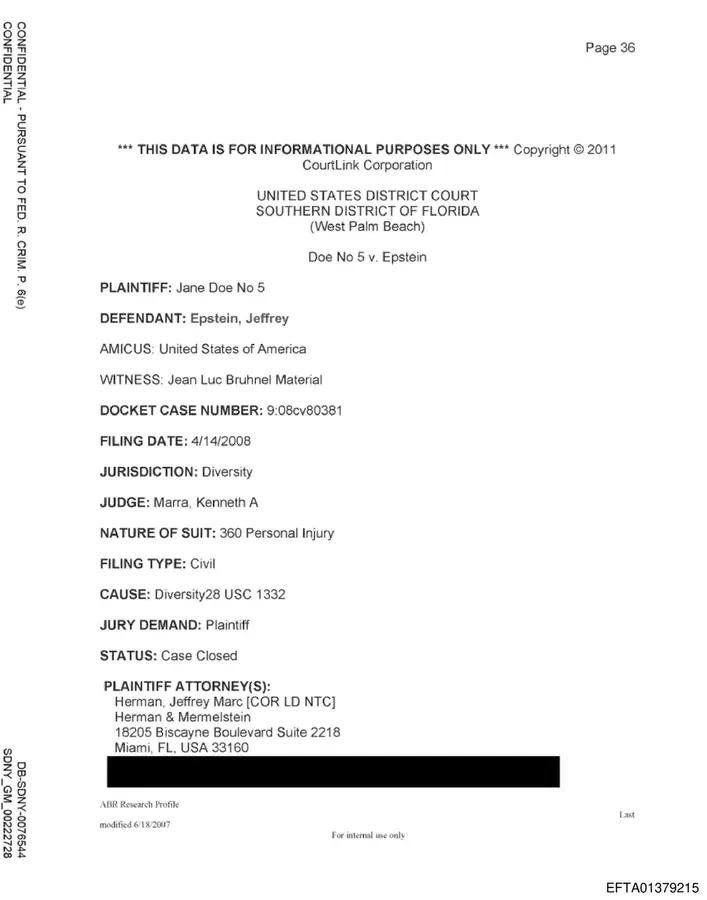
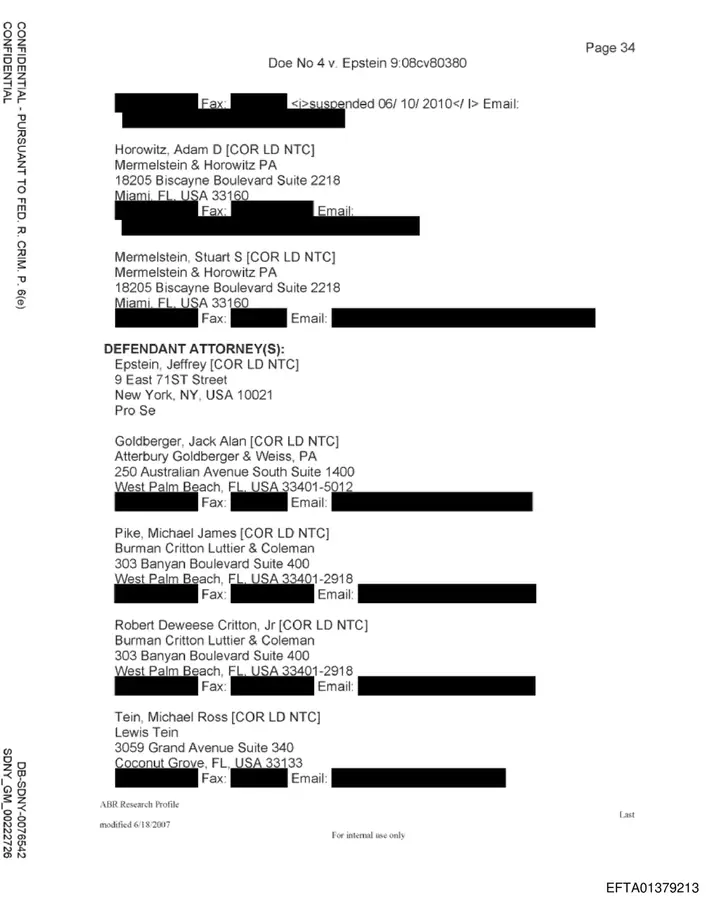
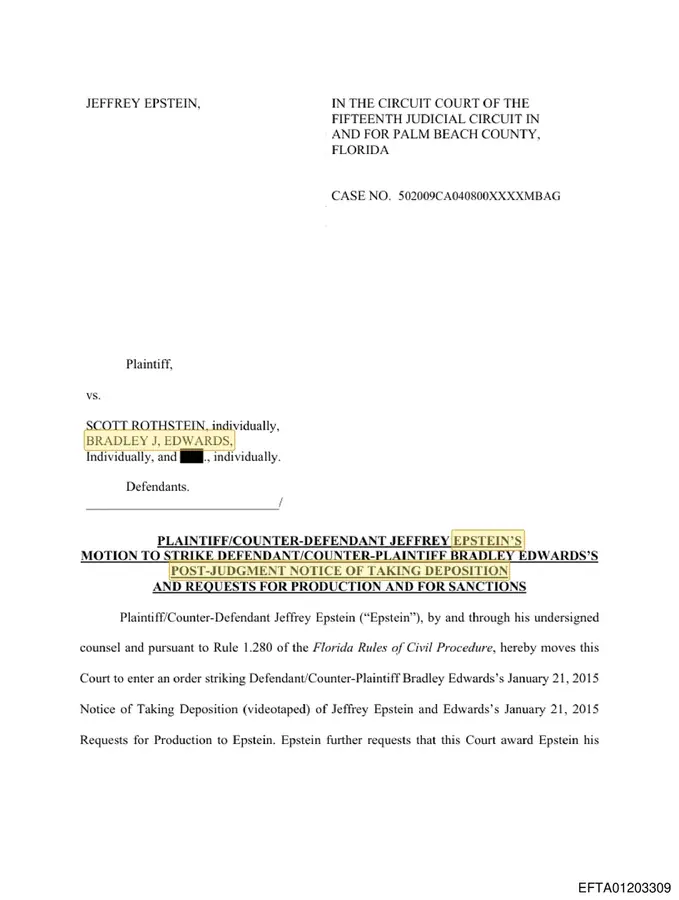
The DOJ corpus adds context around that litigation machinery even though it does not reproduce the Trump scheduling email itself. One DOJ docket page shows Doe No. 5 v. Epstein filed in the Southern District of Florida on April 14, 2008 [7]. Another DOJ-preserved page from Doe No. 4 v. Epstein lists Jack Goldberger and Robert Deweese Critton Jr. among Epstein's defense lawyers [8] — the same surnames that surface in the 2009 oversight email traffic from Burman Critton Luttier & Coleman. And a later DOJ file shows Epstein moving to strike a Bradley J. Edwards post-judgment deposition notice in Florida circuit court, confirming that deposition fights with the same plaintiffs' lawyer were preserved elsewhere in the federal release [18].
That context is why the most defensible reading is also the narrowest one. The oversight records reviewed for this article show notice, delay, rescheduling, and procedural uncertainty [3][4][6]. They show Maxwell moved from August 17 to September 23 and Trump moved from August 18 to September 24 [3][4]. They do not, in the material cited here, provide Trump's transcript, a completed return of service, or the substance of any sworn answers from him. The surviving record is the calendar, the Fifth Amendment invocations, and the victim account. The missing record is the testimony itself. [3][4][6][7][8][13][16][18] That gap is exactly what makes the 2009 paper trail worth revisiting now: it shows a legal path that existed, even if the released files do not show where it ended.
 View source document
 View source document
 View source document
 View source document
Document Timeline
Doe No. 5 v. Epstein filed in the Southern District of Florida.
[7]In a deposition, Epstein invokes the Fifth Amendment when asked whether he socialized with Trump in the company of females under 18.
[13]The same email chain says an emergency protective order has just been filed.
[3]Maxwell's deposition is reset from August 17 to September 23, and Trump's deposition is scheduled for August 18.
[3]A follow-up email says Trump has been moved to September 24.
[4]Maxwell avoids her deposition, claiming her mother is sick and she cannot leave England.
[12]Maxwell is photographed at Chelsea Clinton's wedding in the United States, contradicting the sick-mother claim.
[12]Katie Johnson files a civil complaint in California naming Trump and Epstein as defendants.
[20]Tiffany Doe signs a sworn affidavit stating she witnessed abuse by Trump and Epstein and faced threats after speaking about minors being abused.
[21]Maxwell's lawyer says she is prepared to speak fully if granted clemency and says Trump did nothing wrong.
[1]Trump declares himself "fully exonerated" after the DOJ releases another batch of Epstein files. A White House spokeswoman says he has been "totally exonerated on anything relating to Epstein."
[19]NBC New York / AP reports that the Justice Department is reviewing withheld Epstein-related files, including Trump-linked records.
[2]Why The 2026 Clemency Story Revives The 2009 Trail
Trump's "total exoneration" claim and Maxwell's clemency offer have framed the current Epstein story as a political question — whether the files help or hurt Trump [1][2][19]. The older documents sharpen a different accountability issue. If Trump's role in Epstein-related civil litigation was important enough in 2009 to justify a scheduled deposition, then a rescheduled one, what became of that line of inquiry? If Epstein took the Fifth rather than answer whether Trump socialized with underage females, what would Maxwell say about it now under oath — not in a press statement, but in a deposition room [13]? The files reviewed here do not answer those questions. What they do show is that the questions are not newly invented by 2026 headlines [3][4][5][13]. Trump appears in this record not only through allegation coverage or tabloid-style references, but through formal legal scheduling, an attorney affidavit, a victim account originating at Mar-a-Lago, a later-preserved civil complaint, a sworn supporting affidavit, and a deposition in which Epstein refused to answer the core question [3][4][5][13][16][20][21].
That matters even more in a month when the Justice Department has already come under scrutiny for how Trump-linked Epstein materials were handled in the public release [2]. Maxwell's clemency pitch arrives in a climate where delayed or withheld records are themselves part of the story [2]. Her present-tense promise to clear Trump does not erase the older fact that a Jane Doe case had already put him on the deposition track — and that later DOJ-preserved allegation filings kept the Trump-Epstein claim trail alive in 2016. [1][3][4][5][12][13][16][20][21] The accountability question is therefore straightforward: not whether Trump declares himself exonerated or Maxwell offers to clear his name, but why a documented discovery and allegation trail — one that generated Fifth Amendment refusals, deposition scheduling, a victim account running through Mar-a-Lago, and later preserved complaint-and-affidavit material — still ends in a public record gap [19][1][20][21].
Trump says he has been "fully exonerated." Maxwell offers to confirm it in exchange for clemency. The released files offer something neither claim addresses: a legal process in which a victim was recruited at Mar-a-Lago, Epstein took the Fifth about Trump and underage females, Trump was placed on the formal deposition calendar, and later DOJ-preserved filings carried the allegation trail into 2016. [19][1][3][5][13][16][20][21]
Frequently Asked Questions
- Has Trump been 'totally exonerated' by the Epstein files?
- Trump and the White House have claimed 'total exoneration,' but the DOJ made no such announcement. The House Oversight records show Trump's deposition was scheduled in a Jane Doe case, Epstein took the Fifth when asked about Trump and underage socializing, and a victim says she was recruited at Trump's Mar-a-Lago. The files do not prove criminal conduct by Trump, but they do not support a claim of exoneration either.
- Do the released files show that Trump actually sat for a deposition in 2009?
- Not in the records cited here. The oversight files show scheduling and rescheduling — Trump was set for August 18 then moved to September 24, 2009 — but they do not include a Trump deposition transcript or sworn testimony excerpt.
- What do the 2009 emails actually prove?
- They prove that Trump's name appeared in the formal discovery calendar of a Jane Doe civil matter tied to Epstein and Maxwell, that Maxwell's deposition was rescheduled, that Trump's date was later moved from August 18 to September 24, and that the same law firm was simultaneously requesting juvenile records for the victim.
- Did Epstein answer questions about Trump in a deposition?
- No. In an earlier deposition, Epstein invoked his Fifth Amendment right when asked directly whether he had socialized with Trump in the company of females under 18. The Fifth Amendment protects against self-incrimination and cannot legally be treated as an admission of guilt.
- Why does Maxwell's 2026 clemency pitch make these old emails newly relevant?
- Because Maxwell is now offering a public exculpatory account of Trump while seeking clemency. The older oversight documents show that Trump's role in Epstein-related victim litigation was already important enough to trigger deposition planning, that Epstein refused to answer about Trump under oath, and that Maxwell herself avoided her own scheduled deposition.
- What do the Katie Johnson and Tiffany Doe files add to this article?
- They show that the released DOJ corpus preserved later Trump-related allegation documents beyond the 2009 scheduling emails. EFTA00622303 is a 2016 civil complaint by Katie Johnson naming Trump and Epstein as defendants. EFTA01250883 is a 2016 sworn affidavit from Tiffany Doe saying she witnessed abuse and faced threats after speaking about minors being abused. They are allegation documents, not judicial findings, but they extend the document trail the article discusses.
- What was Trump's connection to the Jane Doe victim litigation?
- Virginia Giuffre was recruited by Ghislaine Maxwell at age 16 while working as a locker-room attendant at Trump's Mar-a-Lago resort. Plaintiffs' lawyer Bradley Edwards wrote that Trump might have relevant information, and Epstein's personal directory contained 14 phone numbers for Trump.
- Did Maxwell show up for her scheduled deposition in 2009?
- No. According to the oversight filing, Maxwell avoided the deposition by claiming her mother was sick and she could not leave England. She was later photographed at Chelsea Clinton's wedding in the United States on July 31, 2010.
- Were other high-profile figures also targeted for depositions in this litigation?
- Yes. Edwards' filings show deposition notices were also sent to Alan Dershowitz and Bill Clinton, and depositions were considered for Bill Richardson and David Copperfield — all in the same civil litigation stream.