44 Days: How the DOJ Built a Secret Deal That Let Epstein Walk and His Victims Never Knew
Seventeen government files — police letters, prosecutor emails, calendar entries, the plea deal itself, court rulings, and inspector general reports — exposed a federal cover-up that took 12 years and a judge's ruling to confirm.
 View source document
The Deal
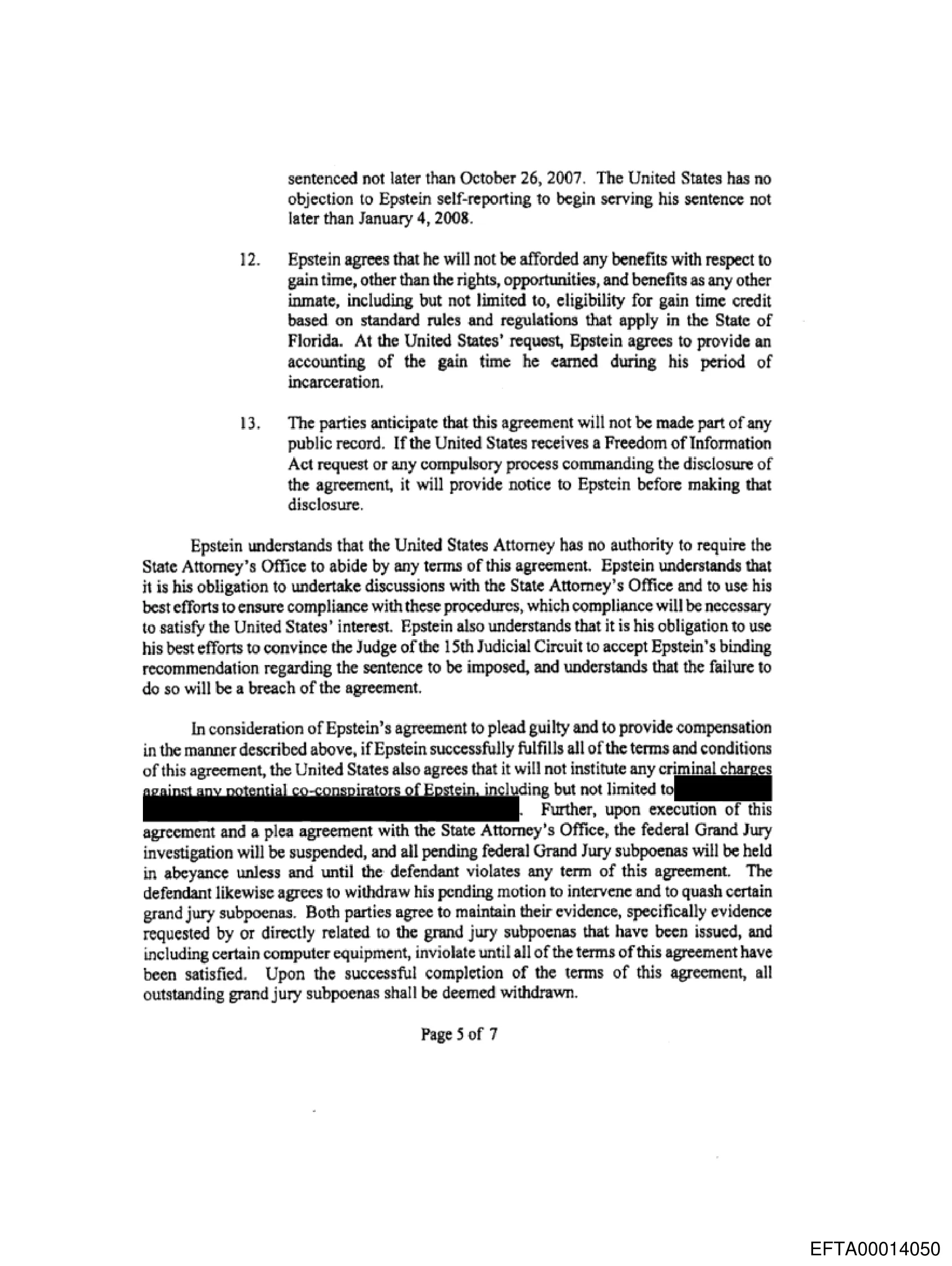
In 2007, U.S. Attorney Alexander Acosta signed a secret deal with Jeffrey Epstein that let a serial child sex trafficker plead guilty to a state prostitution charge, serve 13 months in a county jail with work release, and walk free. The deal granted federal immunity not just to Epstein, but to all of his "known and unknown" co-conspirators — a clause that shielded every person in his network without naming a single one [1]. The victims — girls as young as 14 — were never told the deal was being negotiated. They found out after it was done.
A federal judge later ruled this was not an accident. It was deliberate deception [14]. The DOJ's own investigators confirmed it: Acosta's office broke federal law [15][16]. Acosta himself admitted under oath that the case could have been prosecuted federally [17]. And a DOJ email from 2019 contains a claim that may explain why it wasn't: Acosta allegedly told the Trump transition team that Epstein "belonged to intelligence" and should be left alone [18].
Here is how it happened — from the first warning to the final confirmation — documented in the government's own files.
The Police Chief Who Saw It Coming (May 2006)
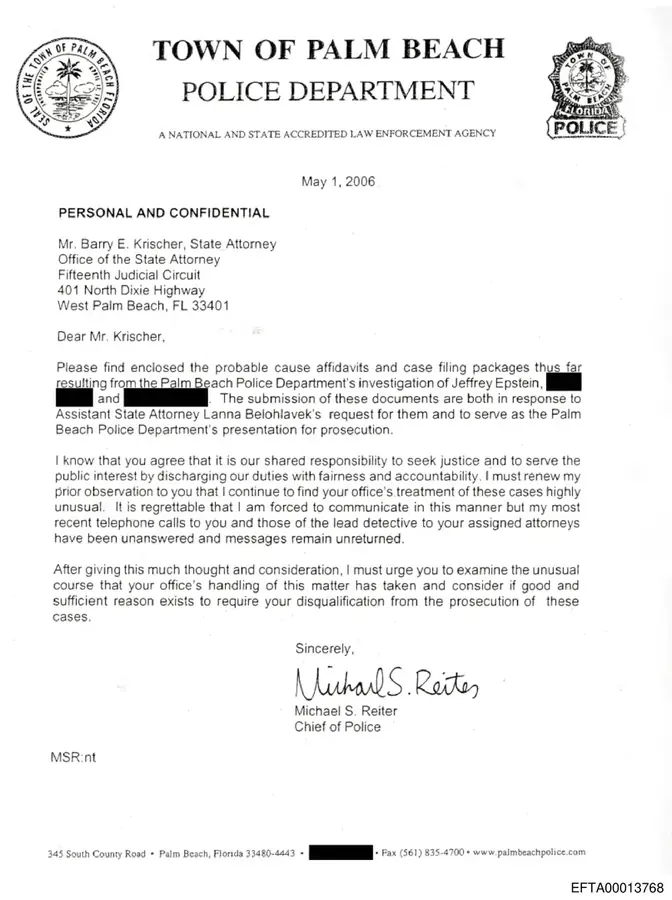
On May 1, 2006, Palm Beach Police Chief Michael S. Reiter sent a confidential letter to State Attorney Barry E. Krischer. His department had built a prosecution-ready case against Epstein — probable cause affidavits, witness testimony, physical evidence. But the state attorney's office wouldn't return the lead detective's phone calls. Reiter called their handling of the case "highly unusual" and urged Krischer to step aside [4].
Krischer didn't step aside. Instead of filing charges himself, he sent the case to a grand jury — a move the Palm Beach Post described as "unusual" at the time, because grand juries are typically used for complex cases, not ones where police have already assembled a complete prosecution package [5]. The grand jury returned a single charge of solicitation of prostitution. Not trafficking. Not sexual abuse of a minor. Solicitation.
Reiter's letter is the earliest document in this timeline. It was written more than a year before the federal deal was signed. The police chief could see in 2006 what it would take the federal courts until 2019 to confirm: someone was protecting Jeffrey Epstein.
 View source document
Forty-Four Days (September–October 2007)
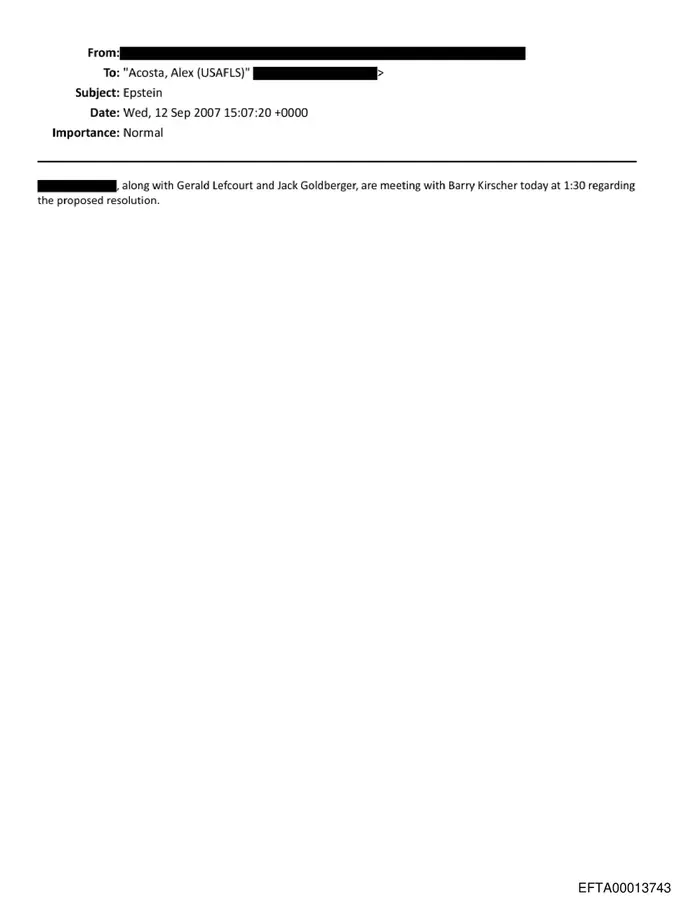
On September 12, 2007, Alexander Acosta — the top federal prosecutor for the Southern District of Florida — sat down with Epstein's defense attorneys Gerald Lefcourt and Jack Goldberger to discuss a "proposed resolution." His own email confirms the meeting [6].
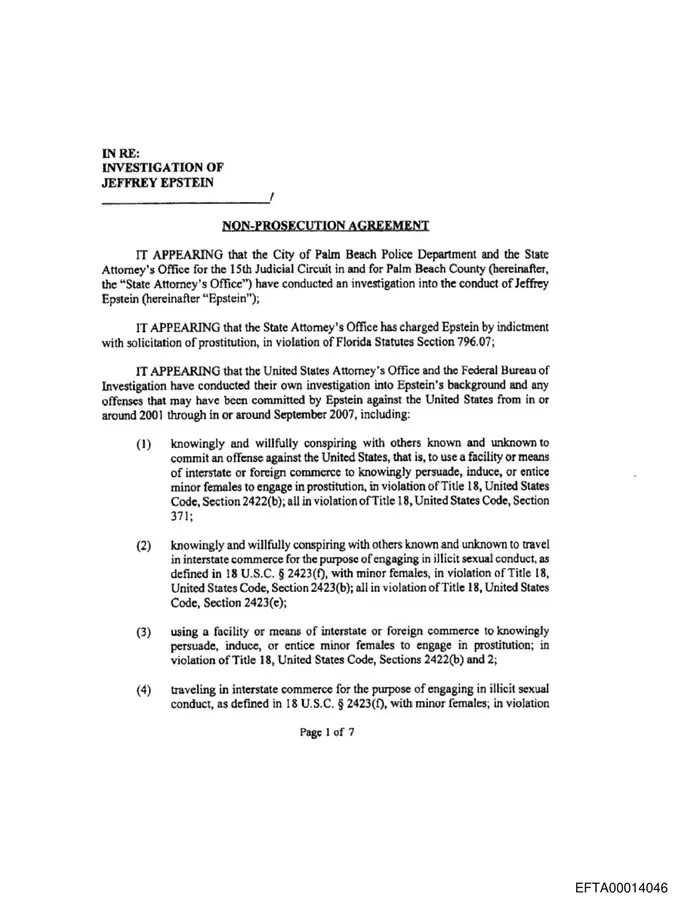
Forty-four days later, on October 26, 2007, the Non-Prosecution Agreement was signed [1].
That is the speed at which the most consequential plea deal in the Epstein case was constructed: six weeks. A case involving dozens of identified victims, years of alleged trafficking across multiple states, and evidence the FBI had been gathering since 2005 — resolved in six weeks through a deal negotiated behind closed doors.
A calendar entry from December 14, 2007 — two months after the NPA was signed — shows Acosta was still personally managing the case. The entry reads: "Epstein Pre-Meet. Location: Alex's Office." DOJ attorney Ann Marie Villafana is listed as attendee [7]. The U.S. Attorney was not delegating this case. He was running it from his desk.
The NPA itself is 14 pages long. Section 1 drops federal charges in exchange for a guilty plea on state charges. The immunity clause protects "other known and unknown" co-defendants — language broad enough to cover anyone who ever participated in Epstein's operation [1]. Section 2 recommends an 18-month sentence. A separate version of the agreement, dated July 10, 2007, shows the deal was renegotiated at least once before the October signing — the July version includes different statutory references and terms [2]. The deal went through multiple drafts. It was not hasty. It was carefully constructed.
An addendum gave Acosta the right to select the attorney who would represent Epstein's victims — with Epstein paying the attorney's fees [8]. And a July 2008 fax from Epstein's lawyers confirms the federal grand jury investigation was suspended as a condition of the agreement [9]. The mechanism that could have led to a federal trial was shut down by design.
 View source document
 View source document
A federal investigation involving dozens of victims and years of trafficking evidence was shut down in exactly 44 days. The resulting deal didn't just protect Jeffrey Epstein — it granted blanket immunity to every unnamed person who ever participated in his crimes [1].
"Epstein Pre-Meet. Location: Alex's Office." — Calendar entry for U.S. Attorney Alexander Acosta, December 14, 2007 [7]
The Victims Found Out After It Was Done (2008)
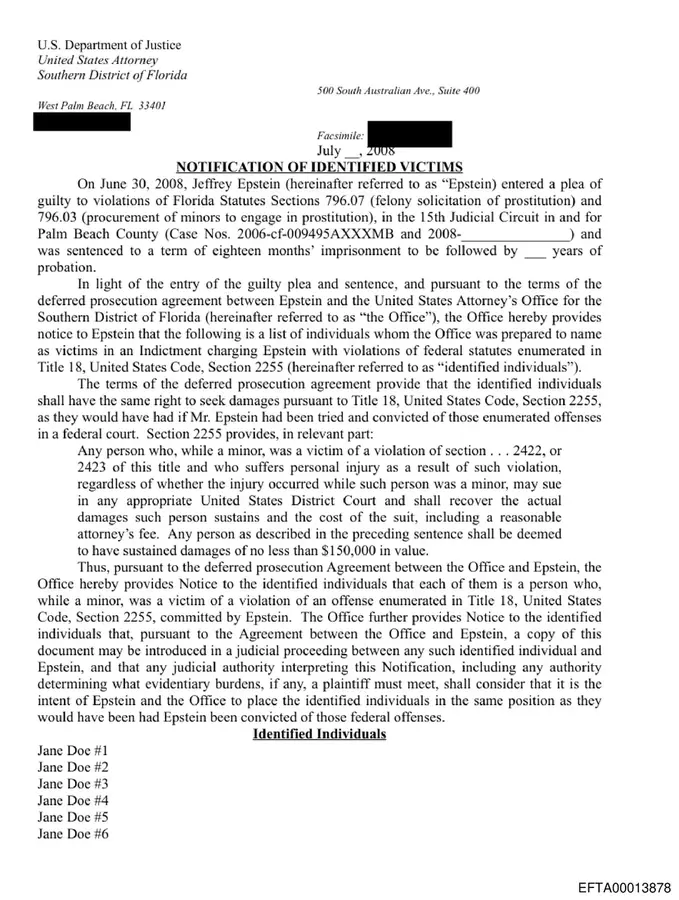
On June 30, 2008, Epstein entered his plea. A notification letter went out to six identified victims — Jane Doe #1 through Jane Doe #6 — informing them of the terms: guilty pleas to Florida Statutes 796.07 (solicitation of prostitution) and 796.03 (procurement of minors), 18 months in county jail, 5 years probation [10].
The letter was signed under Acosta's authority. It outlined a process for filing damage claims. It looked, on paper, like the system working.
But the victims were not consulted when Acosta met Epstein's lawyers in September 2007 [6]. They were not informed when the NPA was signed in October 2007 [1]. They were not told when the grand jury was suspended in July 2008 [9]. By the time the notification letter arrived, every decision that mattered had already been made without them.
Seven days after the plea, Jane Doe filed a petition under the Crime Victims' Rights Act alleging the government entered the deal in secret [11]. The petition cites the federal charges Epstein should have faced: 18 U.S.C. § 1591 (sex trafficking of minors) and § 2422 (interstate enticement). Those charges were never filed.
Four days after that, Acosta sent an email with the subject line "Read: Just got back from Epstein hearing" — marked Urgent, High Importance [12]. The victims had started fighting. The man who built the deal was watching.
 View source document
"The government violated the Crime Victims' Rights Act. Victims were 'deceived' rather than merely failed to be notified." — U.S. District Judge Kenneth A. Marra [14]
Eleven Years Later, a Judge Said It Was Illegal (2019)
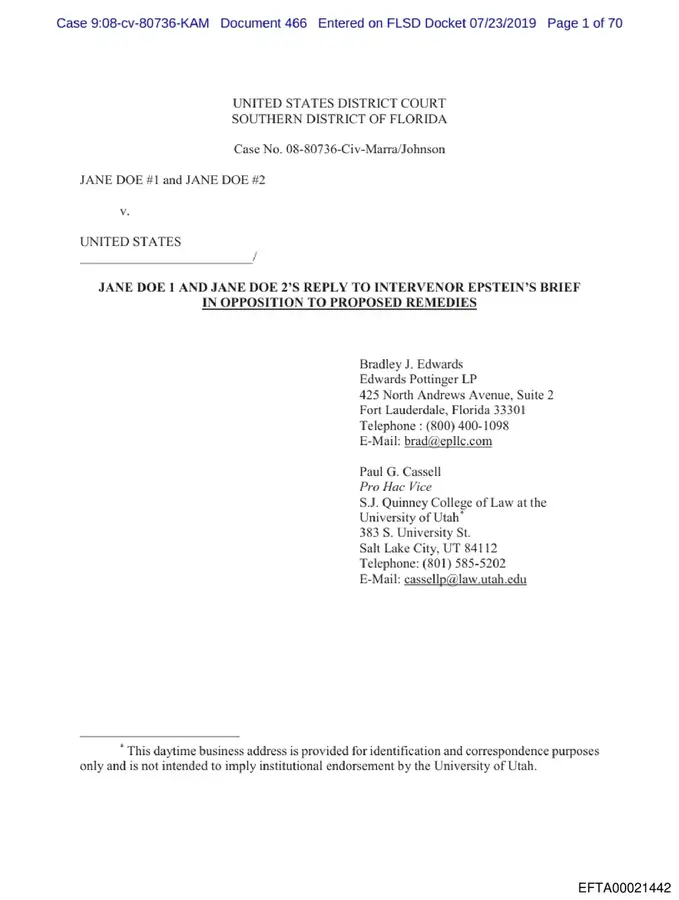
The victims' CVRA challenge ground through the federal courts for over a decade. Their attorneys — Bradley Edwards and Paul G. Cassell — filed briefs arguing the NPA was invalid because the government excluded victims from every stage of the negotiation [13]. The government's position was that victims had no right to know about the plea agreement — an argument that a federal judge would eventually destroy.
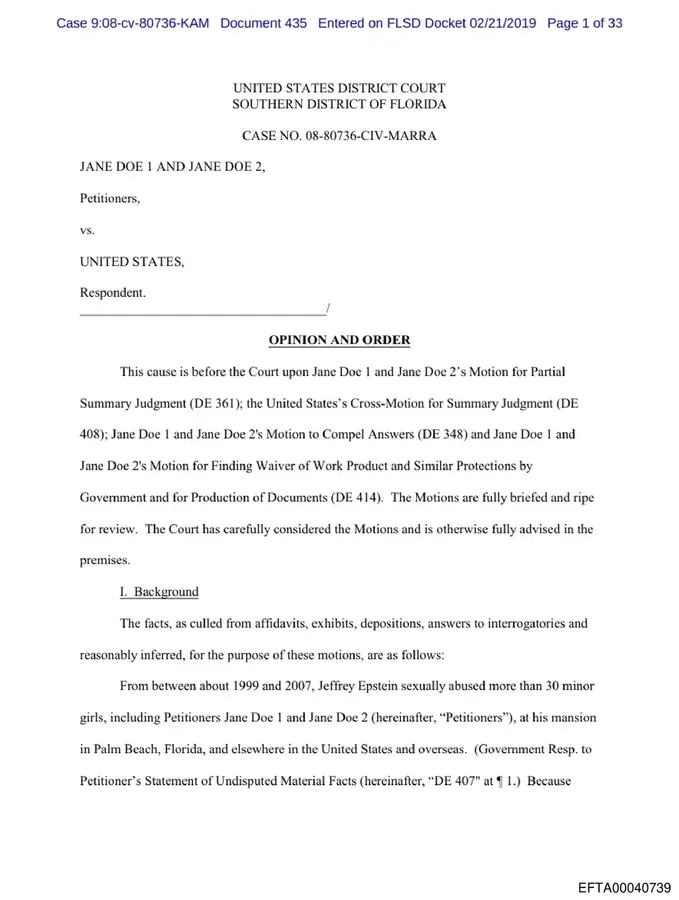
In February 2019, U.S. District Judge Kenneth A. Marra issued a 33-page opinion. His finding was not that the government made an administrative error. It was that the government actively deceived Epstein's victims [14]. The ruling laid out a timeline: on February 1, 2007, Epstein's defense team met with prosecutors. By July 6, 2007, federal agents had enough information to notify victims but didn't. On September 24, 2007, still no notification. The NPA was signed in October. The victims learned about it months after it was final.
The government hid its intentions. It misled victims about the status of the investigation. It entered a deal that terminated their rights without their knowledge. And it took eleven years for a court to say so.
 View source document
 View source document
The DOJ Confirmed It: Their Own Prosecutors Broke the Law (2020)
After Judge Marra's ruling, the DOJ's Office of Professional Responsibility investigated its own prosecutors. Two OPR reports were released under the File Transparency Act, and both reach the same conclusion: Acosta's office violated federal law and professional standards [15][16].
The primary OPR report — scored at 95, the highest-importance document in this investigation — states that Acosta's office signed the NPA permitting Epstein to plead to state charges while evading federal prosecution, and failed to notify victims as required by the Crime Victims' Rights Act. It identifies Acosta as personally responsible [15].
The second OPR report goes further. It alleges the office misled the court about the NPA's terms, failed to consult with victims, and engaged in a pattern of conduct that constitutes a cover-up. It provides a timeline from 2005 to 2020 and names Acosta as the lead prosecutor who failed to fulfill his responsibilities [16].
The DOJ investigated its own people and found they broke the law. The natural question is: what happened next? The answer, as far as the released documents show, is nothing. Neither OPR report references disciplinary action against any prosecutor.
 View source document
A federal judge ruled the government deliberately deceived Epstein's victims [14]. Two internal DOJ investigations confirmed that Alexander Acosta's office broke federal law [15][16]. Yet according to the released files, not a single prosecutor faced disciplinary action for the cover-up.
Acosta's Admissions — And the Intelligence Claim
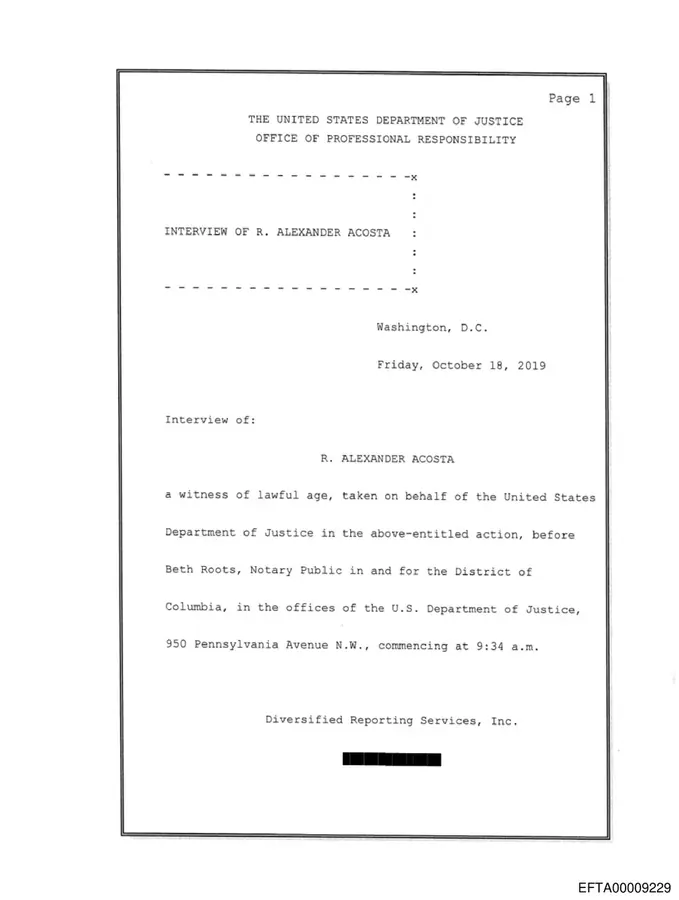
In a 100-page interview with OPR investigators, Acosta addressed his handling of the case under oath. The transcript is in the DOJ release [17]. He acknowledged the case could have been prosecuted federally. He was aware of the legal framework that would have supported federal charges. He admitted he did not fully investigate the scope of the evidence.
The transcript names other officials involved: Barry Krischer, the state attorney whose office the police chief had flagged in 2006. Gordon D. Todd. T.J. Herron. William Jefferson Clinton is mentioned [17].
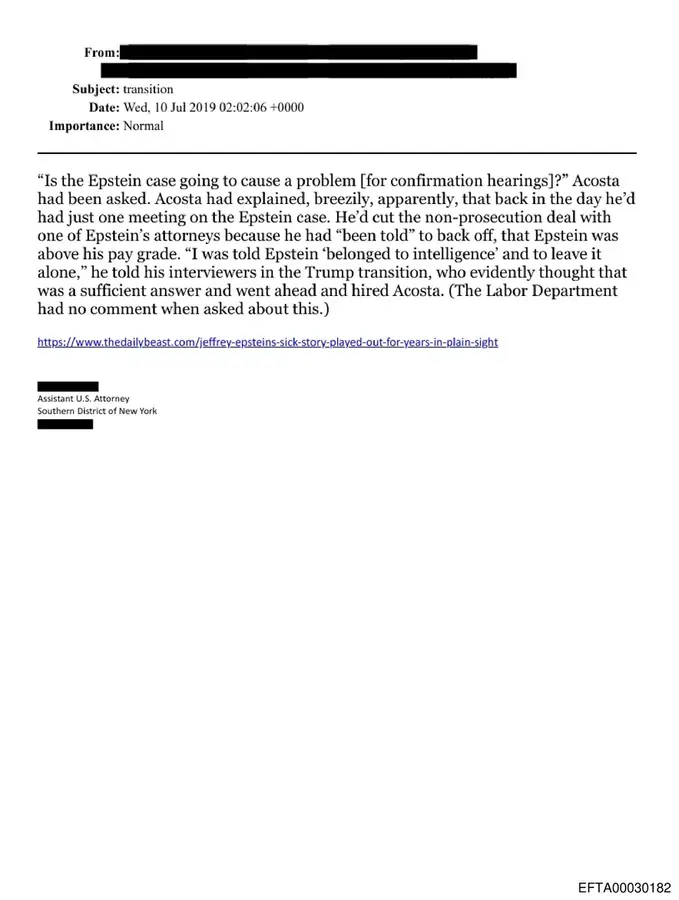
But the document that reframes the entire timeline is a single email from a different part of the DOJ release entirely. On July 10, 2019 — days after Epstein's arrest by the Southern District of New York — an Assistant U.S. Attorney circulated an email stating that Acosta told the Trump transition team Epstein "belonged to intelligence" and should be left alone [18]. According to the email, Acosta provided this explanation for why he cut the non-prosecution deal, and the Trump transition team subsequently appointed him Labor Secretary.
This is an allegation, not a confirmed fact. The email relays a media report, not firsthand knowledge. But place it against the rest of the timeline: a deal constructed in 44 days. Victims deliberately excluded. The U.S. Attorney personally managing the case from his office. Federal law broken with no consequences. An OPR investigation that confirmed the violations but produced no discipline. If the intelligence claim is true, every anomaly in the sequence has an explanation. If it isn't, the anomalies remain unexplained.
 View source document
 View source document
"Acosta stated that Epstein 'belonged to intelligence' and should be left alone." — Email from Assistant U.S. Attorney, Southern District of New York, July 10, 2019 [18]
What the Documents Don't Answer
The files prove the cover-up. They don't prove everything.
They don't establish whether the intelligence claim is true. EFTA00030182 reports what Acosta allegedly said, not whether Epstein actually had intelligence ties. The email relays a media report. It is an allegation.
They don't identify the "known and unknown co-conspirators" the NPA shielded. The immunity clause protects unnamed people. The documents don't say who they are.
They don't explain why nobody was punished. Two OPR reports found federal law was broken. No disciplinary action appears in the released files. Acosta resigned as Labor Secretary in July 2019 after Epstein's re-arrest but faced no legal consequences for the CVRA violations.
And multiple documents contain redactions. What's behind them could change the story.
But what the files do prove is this: the U.S. Department of Justice secretly negotiated a deal that let a child sex trafficker serve 13 months. It deliberately hid the deal from his victims. A federal judge ruled the government deceived those victims. The DOJ's own investigators confirmed its prosecutors broke the law. And nobody was held accountable.
Those are not allegations. Those are the government's own records, now public, linked below. Read them.
Frequently Asked Questions
- What was the Epstein non-prosecution agreement?
- The NPA was a secret deal signed on October 26, 2007, between U.S. Attorney Alexander Acosta and Jeffrey Epstein's defense attorneys. It allowed Epstein to plead guilty to state prostitution charges and serve 13 months in county jail instead of facing federal sex trafficking charges that could have carried a life sentence. It also granted immunity to all 'known and unknown' co-conspirators.
- Were Epstein's victims told about the plea deal?
- No. The victims were not consulted during negotiations and were not informed when the NPA was signed in October 2007. They received a notification letter only after Epstein entered his plea in June 2008. A federal judge later ruled this was deliberate deception, not an administrative oversight.
- Did Alexander Acosta say Epstein belonged to intelligence?
- A July 2019 DOJ email states that Acosta told the Trump presidential transition team that Epstein 'belonged to intelligence' and should be left alone. This is an allegation relayed through a media report, not a firsthand confirmation, and Acosta has not publicly addressed it in detail.
- How fast was the Epstein plea deal negotiated?
- The deal was constructed in 44 days. Acosta met with Epstein's defense attorneys on September 12, 2007, and the Non-Prosecution Agreement was signed on October 26, 2007 — resolving a case involving dozens of identified victims and years of alleged trafficking.
- Was anyone punished for the Epstein plea deal cover-up?
- No. Two DOJ Office of Professional Responsibility reports confirmed that Acosta's office violated federal law and the Crime Victims' Rights Act. However, according to the released files, no prosecutor faced disciplinary action. Acosta resigned as Labor Secretary in July 2019 but was never charged.