Richard Kahn Told Congress He Saw No 'Red Flags.' The DOJ Files Tell a Different Story.
Epstein's longtime accountant testified under oath that he never saw signs of abuse and that his role was 'strictly professional.' But 48,081 DOJ file records — including emails about 'money to girls,' instructions to remove people from Epstein's island, FBI financial surveillance alerts, and a trust making Kahn's family beneficiaries — contradict those claims point by point.
 View source document
What Kahn Told Congress
On March 11, 2026, Richard Kahn sat for a closed-door deposition before the House Oversight and Government Reform Committee. The session lasted approximately seven hours [1]. Kahn, Jeffrey Epstein's accountant since 2005 and co-executor of his estate, told lawmakers four things: that he "was not aware of the nature or extent of Epstein's abuse of so many women until after Epstein's death" [1]; that he "never observed any sexual abuse or trafficking of women and never received a complaint" [1]; that he "did not see" gifts Epstein made to women and men "as red flags for abuse or trafficking" [1]; and that his relationship with Epstein was "strictly on a professional level" [2]. He described Epstein's financial practices as "completely standard practice" [2]. He said that if he had learned of Epstein's conduct, he "would have quit work immediately" [1].
Rep. James Walkinshaw, who was present, noted Kahn's extensive "inability to recall" emails, text messages, and activities throughout the deposition [3]. Ranking Member Robert Garcia said afterward that "it's not credible that he had no knowledge of Epstein's activities" [4].
The DOJ File Transparency Act corpus — the same 1.4 million documents released under court order — contains 48,081 records mentioning Richard Kahn [5]. Dozens of those documents directly contradict what Kahn told Congress. What follows is the testimony, placed next to the files.
Richard Kahn told the House Oversight Committee he never saw red flags. The government's own files show he was copied on emails about 'money to girls,' received instructions to move people off Epstein's island, and was placed under FBI financial surveillance alongside Ghislaine Maxwell and Jean-Luc Brunel. [5][6][7][8]
'I Did Not See Them as Red Flags'
Kahn told Congress that while he tracked expenditures including gifts Epstein gave to women and men, he "did not see them as red flags for abuse or trafficking" and that these gifts were "a very small fraction of Epstein's spending" [2]. He called Epstein's financial arrangements "completely standard practice" [2].
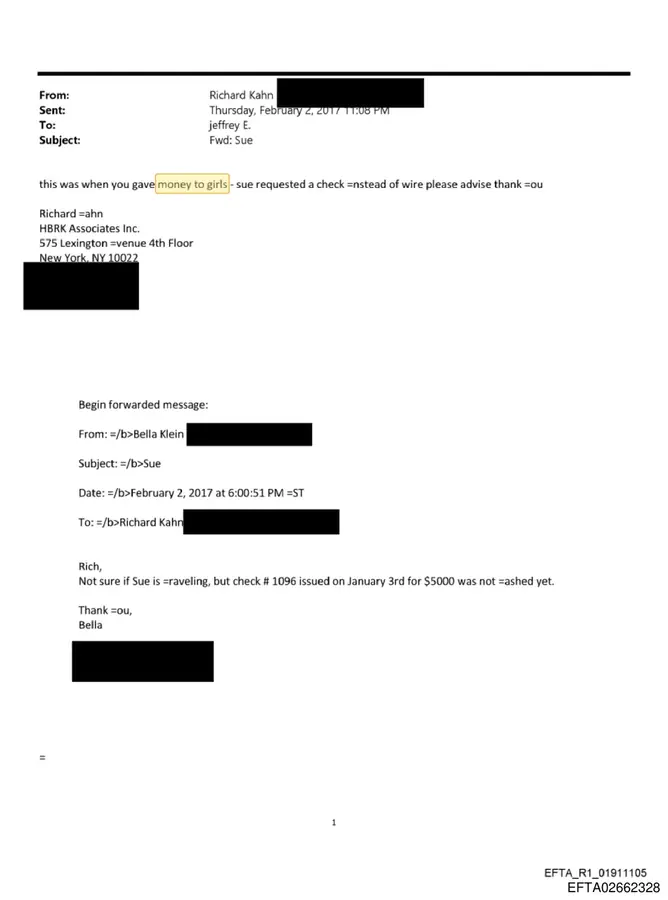
The files show something different. On February 2, 2017, Kahn emailed Epstein directly with the subject line "Fwd: Sue." His message to Epstein read: "this was when you gave money to girls - sue requested a check instead of wire please advise" [6]. The forwarded email from Bella Klein noted that check #1096, issued January 3, 2017 for $5,000, had not been cashed [6]. Kahn used the phrase "money to girls" — not "client gifts" or "standard disbursements" — in a routine email to Epstein about a payment. It was his own language, not imposed by the document's metadata or any later interpretation [6].
Separately, on September 27, 2013, Epstein emailed Lesley Groff, Richard Kahn, and others with the instruction "give her 25k" in response to a request about "Barbro's Fund" [9]. Groff's preceding message described the fund as supporting a school that "does so much good for so many girls" [9]. This particular payment appears to reference a legitimate charitable donation to a school in Sweden run by Barbro Ehnbom. But the broader pattern — in which Kahn was routinely looped into payments involving women and girls, used the phrase 'money to girls' in his own correspondence, and then told Congress he saw nothing unusual — is what the files challenge. [6][9]
View source document"this was when you gave money to girls - sue requested a check instead of wire please advise" — Richard Kahn to Jeffrey Epstein, February 2, 2017 [6]
'I Never Observed Any Sexual Abuse or Trafficking'
Kahn testified that while Epstein was alive, he "never observed any sexual abuse or trafficking of women and never received a complaint — either by one of Epstein's victims or anyone else — of such abuse or trafficking" [1].
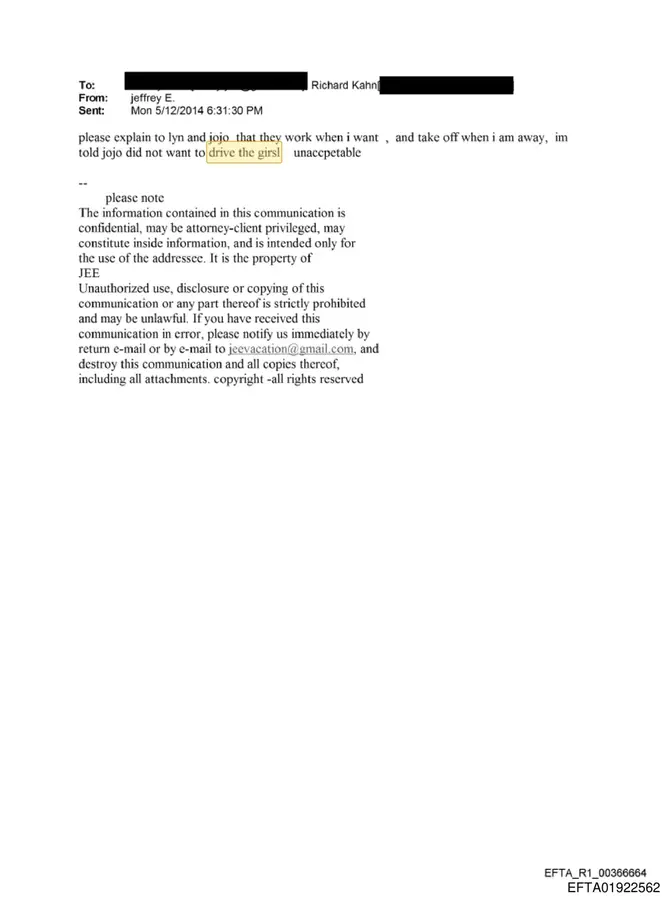
The files show Kahn was on the receiving end of Epstein's operational directives about women. On May 12, 2014, Epstein sent an email that Richard Kahn received, stating: "jojo did not want to drive the girsl unaccpetable [sic]" and instructing that "lyn and jojo" should understand "they work when i want" [7]. The reference to driving "the girsl" — a misspelling in Epstein's original email — came with a directive that staff compliance was mandatory, framed not as a request but a reprimand [7].
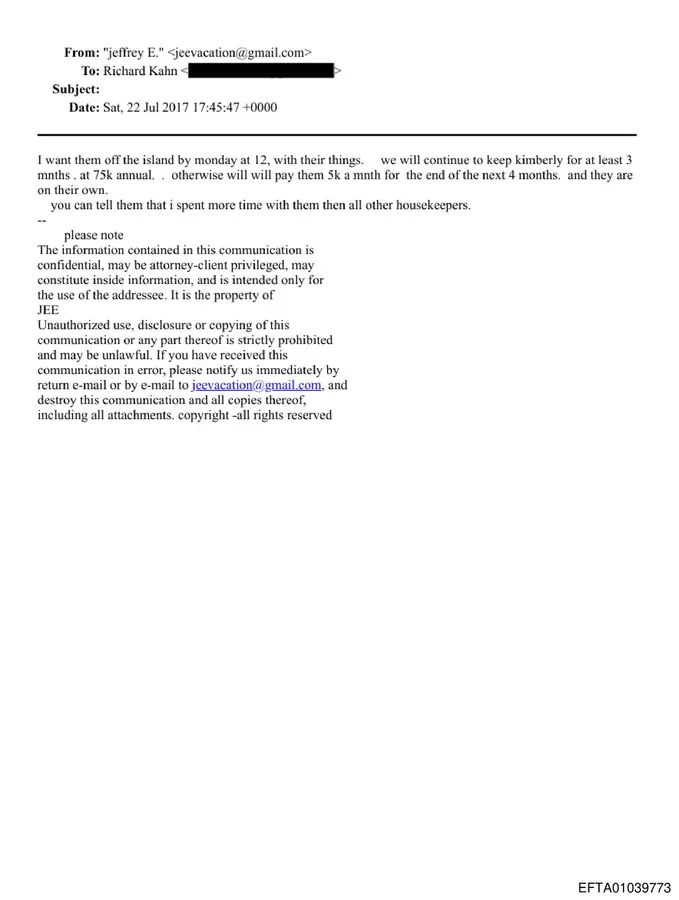
In a separate July 22, 2017 email to Kahn, Epstein discussed paying $75,000 per year — or $5,000 per month — for "keeping Kimberly" for at least three months, and instructed Kahn to "get them off the island by Monday at 12" with their belongings [10]. The email noted that he would "spend more time with them than all other housekeepers" [10]. The document carries attorney-client privilege markings and instructions to destroy unauthorized copies [10].
Another March 23, 2018 email from Epstein to Kahn referenced a "year-old concern regarding children distributions" that someone named Deborah refused to address [11]. Combined with an email referencing someone who "did not receive her money," the pattern is of Kahn receiving routine operational detail about payments to and logistics for unnamed women, specific instructions about moving people on and off Epstein's island, and language about "children" in a financial distribution context [11][12].
No single email proves Kahn witnessed abuse. But his claim that he never received information that could constitute a complaint or a warning is contradicted by the volume and content of what arrived in his inbox. [7][10][11][12]
 View source document
 View source document
'Strictly Professional'
Kahn told Congress his connection with Epstein was "strictly on a professional level" [2]. The trust documents tell a different story.
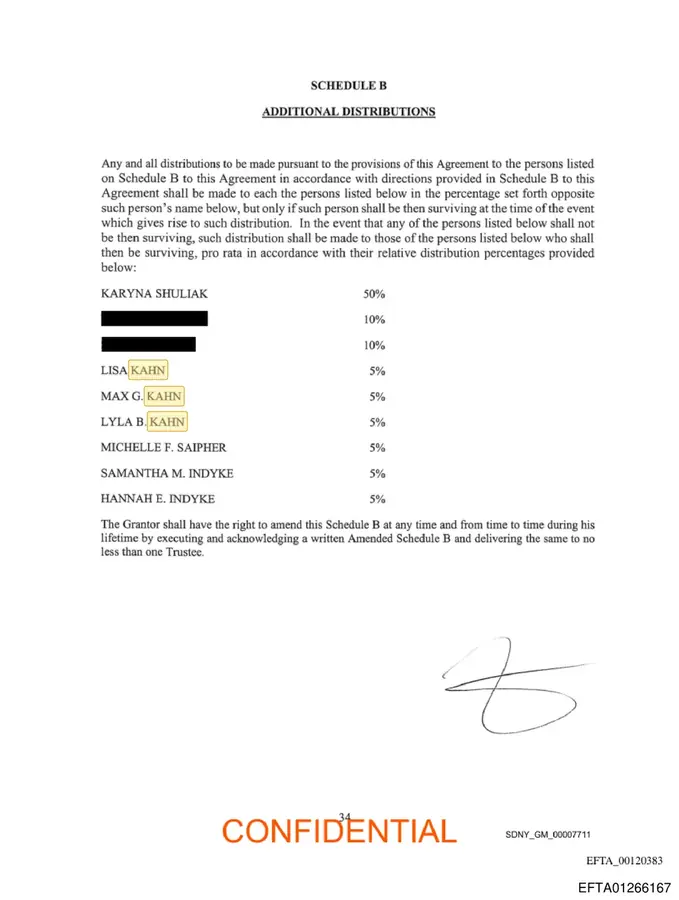
The January 18, 2019 Jeffrey E. Epstein 2019 Trust names Darren K. Indyke and Richard D. Kahn as trustees [13]. Schedule B of the same trust — titled "Additional Distributions" — lists three members of the Kahn family as beneficiaries: Lisa Kahn at 5%, Max G. Kahn at 5%, and Lyla B. Kahn at 5% [13]. That is 15% of the trust's additional distributions directed to what appear to be Kahn's family members, alongside Karyna Shuliak at 50% and two Indyke family members at 10% combined [13]. The document was signed less than seven months before Epstein's death [13].
A later amended trust dated February 4, 2019 went further, directing a $20 million bequest to "Richard David Kahn, if he survives me" [14]. It also contained a continuity clause requiring that beneficiaries who provided services to Epstein, his entities, or HBRK Associates had to continue for two years after Epstein's death to collect their bequests [14]. The trust was not merely paying Kahn for accounting work. It was embedding his family into Epstein's wealth distribution and tying his continued involvement to a multi-million-dollar incentive [14].
A man whose family stands to receive 15% of a trust's distributions and who is personally directed $20 million in a separate bequest is not in a 'strictly professional' relationship. He is in a financial partnership. [13][14]
 View source document
The same man who told Congress his relationship was 'strictly professional' was named trustee, $20 million beneficiary, and had three family members written into Epstein's trust distribution schedule seven months before Epstein's death. [13][14]
'Completely Standard Practice'
Kahn described Epstein's financial arrangements as "completely standard practice" [2]. The files show that multiple regulatory bodies disagreed.
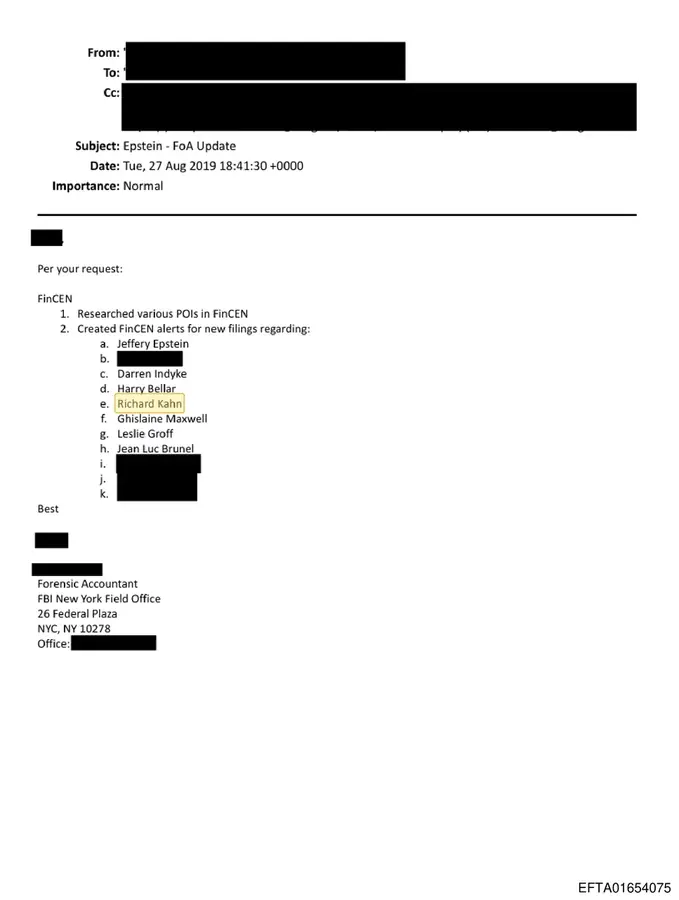
On August 27, 2019, an FBI forensic accountant at the New York Field Office created FinCEN alerts for new filings regarding a list of persons of interest: Jeffery Epstein, Darren Indyke, Harry Bellar (Beller), Richard Kahn, Ghislaine Maxwell, Leslie Groff, and Jean Luc Brunel [8]. Kahn was placed on the same FBI financial surveillance list as Epstein's convicted co-conspirator and a man who later died in a French prison while awaiting trial [8].
Deutsche Bank's own compliance records told a parallel story. In December 2014, the bank's AML staff wrote that "Darren K. Indyke and Richard Kahn need to be identified as control persons" because they controlled Southern Trust Company, the sole member of Southern Financial LLC [15]. A separate alert review noted that Kahn had been "fined for unregistered activity" at Wells Fargo and flagged his name in a WISE Equities Rule violation for failing to provide testimony requested by FINRA [15][16]. By 2018, Deutsche Bank was rejecting KYC filings for Epstein entities that listed Kahn as a signatory [17].
Financial practices that trigger FBI FinCEN alerts, Deutsche Bank AML escalations, FINRA violations, and KYC rejections across multiple institutions are not what regulators call "completely standard." [8][15][16][17]
 View source document
Named as Co-Defendant in a Federal Trafficking Complaint
Kahn also told Congress that he believed Epstein's 2006 arrest "was a mistake" because Epstein told him "he did not know the woman was underage, and that nothing like that would happen again" [1]. He accepted this explanation and continued working for Epstein for thirteen more years.
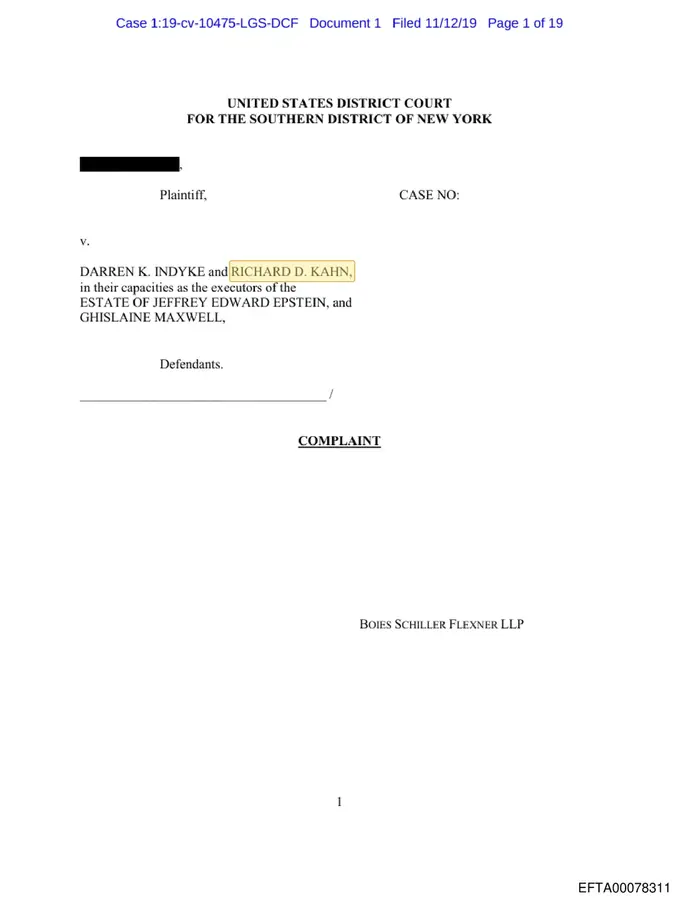
By November 2019, Kahn was named as a co-defendant — in his capacity as co-executor — in a federal sex trafficking complaint filed in the Southern District of New York (Case 1:19-cv-10475-LGS-DCF) [18]. The plaintiff alleged sexual abuse beginning at age 16, trafficking as part of an organized ring, assault at Zorro Ranch in New Mexico, and intimidation by Ghislaine Maxwell [18]. The complaint cited Epstein's own quote to the New York Post: "I'm not a sexual predator, I'm an offender. It's the difference between a murderer and a person who steals a bagel" [18].
The USVI Attorney General separately alleged that Indyke and Kahn, as estate administrators, had fraudulently suppressed victim compensation claims [19]. In February 2026, Reuters reported the estate agreed to a proposed settlement of up to $35 million, with no admission of wrongdoing [20]. Kahn also admitted during his deposition that he and Indyke had facilitated a fake marriage between two women connected to Epstein, reportedly for immigration purposes [3].
These are not the professional consequences of standard accounting work. [18][19][20]
 View source document
What Kahn Identified: Five Clients Who Paid Epstein
Despite extensive memory lapses, Kahn did provide one set of substantive answers. Committee Chair James Comer reported that Kahn identified five clients who paid money to Epstein: Les Wexner, Glenn Dubin, Steven Sinofsky (former Microsoft Windows Division President), the Rothschilds, and Leon Black [1][2]. Kahn stated he believed Epstein made his money as "a tax advisor and a financial planner" [2].
The committee also found at least 64 entities in Epstein's financial portfolio, with what Comer described as "a lot of money being transferred around" [1]. Those entities track with what the DOJ files show. Kahn appears in the control paperwork for Southern Trust Company, Southern Financial LLC, Maple Inc. (where Kahn was Treasurer and Director), Butterfly Trust, the 2007 Jeffrey E. Epstein Insurance Trust #3, the 2017 Caterpillar Trust, Gratitude America Ltd, and HBRK Associates Inc., among others [14][15][21][22]. The committee reviewed over 40,000 subpoenaed documents from JPMorgan Chase and Deutsche Bank [1].
The most contested moment of the day involved Democratic Rep. Suhas Subramanyam, who stated publicly that Kahn testified the Epstein estate reached a settlement with a person who had also made accusations against President Donald Trump [23]. Committee Chair Comer disputed that characterization, saying Kahn had testified he "had never seen any type of transaction to Trump or anyone in his family" [24]. The discrepancy remains unresolved along partisan lines [23][24].
Document Timeline
Kahn begins working as Epstein's accountant, according to his testimony.
[1]Epstein arrested on solicitation charge. Kahn says Epstein told him it 'was a mistake' and he 'believed him at the time.'
[1]Southern Trust Company board consent lists Epstein, Indyke, and Kahn as directors.
[15]Epstein tells Kahn to write a $25,000 check for 'Barbro's Fund.'
[9]Epstein emails Kahn: 'jojo did not want to drive the girsl unaccpetable.'
[7]Deutsche Bank AML staff require Kahn and Indyke be identified as control persons for Southern Financial LLC.
[15]Kahn emails Epstein: 'this was when you gave money to girls.'
[6]Epstein emails Kahn about $75,000/year for 'keeping Kimberly' and instructions to 'get them off the island by Monday.'
[10]Trust names Kahn as trustee. Schedule B lists three Kahn family members as beneficiaries at 5% each.
[13]Amended trust directs $20 million bequest to 'Richard David Kahn, if he survives me.'
[14]Jeffrey Epstein found dead. Kahn named co-executor two days prior.
[18]FBI forensic accountant creates FinCEN alerts for Kahn alongside Epstein, Maxwell, Brunel, and Groff.
[8]Kahn named co-defendant in federal sex trafficking complaint (SDNY).
[18]Epstein estate agrees to proposed $35 million settlement; no admission of wrongdoing.
[20]Kahn testifies before House Oversight Committee for approximately 7 hours. Claims he saw no red flags.
[1]DOJ File Counts
What the Files Cannot Tell Us
The DOJ files do not contain a document in which Richard Kahn acknowledges awareness of Epstein's abuse in real time. They do not prove he read every email he received. They do not establish that the phrase "money to girls" referred to trafficking victims rather than other women in Epstein's orbit. The Barbro's Fund payment appears to be a legitimate charitable donation to a school. Some of the language flagged here — "children distributions," "keeping Kimberly" — could have explanations not visible in the available records [6][9][10][11].
What the files do establish is a pattern of proximity and information flow that is difficult to reconcile with the blanket denials Kahn offered Congress. He was on the emails. He was on the wire approvals. He was on the trust documents. He was on the FBI's FinCEN surveillance list. And he told Congress he saw nothing [1][2][5][6][7][8][10][13][14].
Darren Indyke, Epstein's former lawyer and Kahn's co-executor, is scheduled to be deposed by the committee in the coming days [1]. The files linked below are the government's own records. Read them.
Frequently Asked Questions
- What did Richard Kahn say in his testimony to Congress?
- Kahn told the House Oversight Committee on March 11, 2026 that he was not aware of Epstein's abuse until after his death, never observed sexual abuse or trafficking, saw no red flags in Epstein's spending, and that his relationship was 'strictly professional.' He described Epstein's financial practices as 'completely standard.' [1][2]
- Do the Epstein files contradict Richard Kahn's testimony?
- Multiple DOJ files show Kahn using the phrase 'money to girls' in an email to Epstein, receiving instructions about moving people off Epstein's island, and being placed on FBI FinCEN financial surveillance lists alongside Ghislaine Maxwell. Trust documents also show Kahn's family members as beneficiaries, contradicting his claim of a 'strictly professional' relationship. [6][7][8][10][13]
- What is the 'money to girls' email?
- On February 2, 2017, Kahn emailed Epstein with the line 'this was when you gave money to girls - sue requested a check instead of wire please advise,' forwarding a note from Bella Klein about a $5,000 uncashed check. The phrase was Kahn's own language in a routine email to Epstein. [6]
- Was Richard Kahn on the FBI's financial surveillance list?
- Yes. On August 27, 2019, an FBI forensic accountant at the New York Field Office created FinCEN alerts for new filings regarding Kahn, alongside Jeffrey Epstein, Ghislaine Maxwell, Jean Luc Brunel, Darren Indyke, Harry Beller, and Leslie Groff. [8]
- How many times does Richard Kahn appear in the Epstein DOJ files?
- Richard Kahn appears in 48,081 DOJ File Transparency Act records, making him one of the most frequently referenced individuals in the entire corpus. [5]
- Was Richard Kahn a beneficiary of Epstein's trust?
- Yes. The January 18, 2019 trust lists three Kahn family members — Lisa, Max G., and Lyla B. Kahn — as 5% beneficiaries each. The amended February 4, 2019 trust directs a $20 million bequest to 'Richard David Kahn, if he survives me.' [13][14]
- Did Richard Kahn admit to anything during his testimony?
- Kahn admitted to facilitating a fake marriage between two women connected to Epstein for immigration purposes, impersonating Epstein in communications with banks, and confirmed that Epstein spoke about Donald Trump 'a lot.' He also identified five Epstein clients: Les Wexner, Glenn Dubin, Steven Sinofsky, the Rothschilds, and Leon Black. [1][2][3]
- What happens next in the Epstein House Oversight investigation?
- Darren Indyke, Epstein's former lawyer and Kahn's co-executor, is scheduled to be deposed in the coming days. The committee has also voted to subpoena Attorney General Pam Bondi regarding DOJ's handling of released Epstein records, and Commerce Secretary Howard Lutnick has agreed to testify. [1]