60 Counts, 27 Victims, One Plea Deal: The Prosecution History DOJ Withheld for Five Weeks
Beyond the Trump-linked FBI interviews, the March 5 Dataset 12 backfill included four Operation Leap Year prosecution memos seeking a 60-count indictment, an immunity memo targeting Lesley Groff, the 582-page FBI file that restarted the investigation in 2018, and a Peter Nygard crossover report. Sixteen files, 900+ pages of prosecutorial history — all withheld from the January 30 mandated release.
 View source document
What the Documents Show
On March 5, 2026, the Department of Justice added 20 new files to its Epstein public database — files that had been absent from the January 30 mass release of 3.5 million pages mandated by the Epstein Files Transparency Act [1]. Four of those files contained FBI interview records documenting abuse allegations against Donald Trump, which we reported on separately [2]. But the remaining 16 documents tell a different and arguably more consequential story: how the federal government built a case to put Jeffrey Epstein in prison in 2007, dismantled it in favor of a secret plea deal, and then rebuilt it from scratch a decade later.
The backfilled package includes four versions of the Operation Leap Year prosecution memoranda totaling 313 pages [3][4][5][6], a June 2008 immunity memo seeking to compel testimony from Epstein's assistants including Lesley Groff [7], the 582-page FBI Electronic Communication that formally reopened the Epstein investigation in December 2018 [8], six additional victim interviews from the Palm Beach and 2019 New York investigations [9], a Palm Beach victim interview documenting abuse beginning at age 14 [10], testimony from Epstein's household employee Janusz Banasiak [11], and a 16-page FBI Tactical Intelligence Report cross-referencing Peter Nygard's 'pamper parties' with the Epstein investigation [12].
These records are the internal paper trail of the most consequential prosecutorial decisions in the Epstein case — the decision to charge, the decision to walk away, and the decision to try again eleven years later. All were withheld from the initial mandated release.
The DOJ initially withheld the prosecution memos that show how close Epstein came to a 60-count federal indictment in 2007, the immunity memo that reveals prosecutors were still building the case even as the non-prosecution agreement was being finalized, and the 582-page FBI file that restarted the investigation in 2018. These are the government's own record of its most significant failures and second chances in the Epstein case.
Key Facts
Operation Leap Year — FBI investigation of Jeffrey Epstein, opened May 2006
DOJ Dataset 12 (VOL00012)
152 (in original OPT file)
172 (20 added outside manifest)
16 files, 900+ pages
4 versions, 313 pages (EFTA02857524, EFTA02857732, EFTA02857763, EFTA02857810)
582 pages (EFTA02857863, dated December 4, 2018)
January 30, 2026
March 5, 2026 (35 days later)
15 documents 'incorrectly coded as duplicative'; 5 prosecution memos initially withheld as 'privileged'
The 60-Count Indictment That Was Never Filed
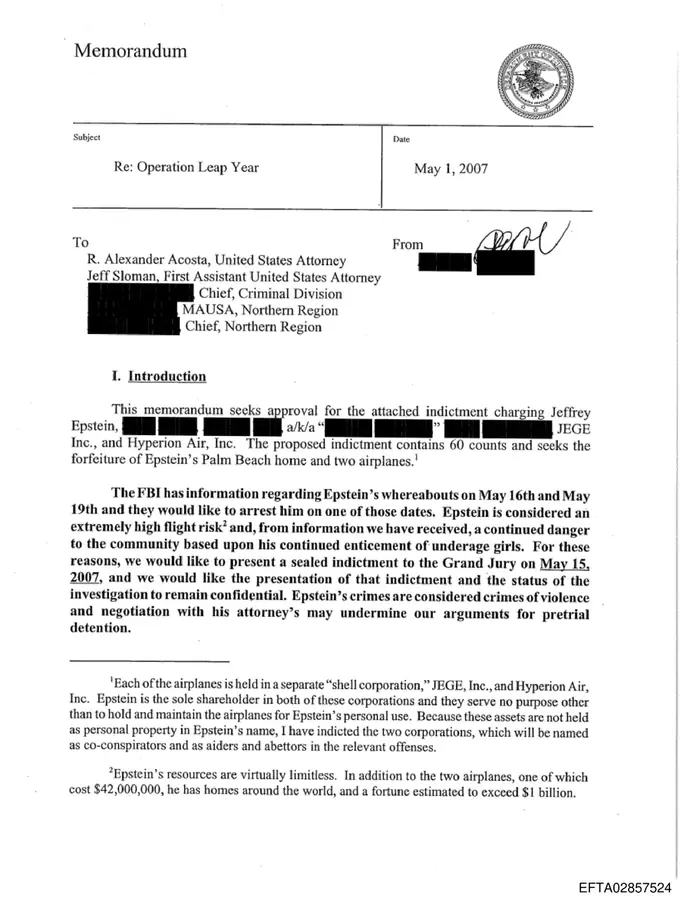
The centerpiece of the backfilled package is EFTA02857524 — a 205-page prosecution memorandum dated May 1, 2007, from a federal prosecutor in the Southern District of Florida to U.S. Attorney R. Alexander Acosta and First Assistant Jeff Sloman [3]. The memo's subject line reads 'Re: Operation Leap Year.' Its opening paragraph states the purpose plainly: 'This memorandum seeks approval for the attached indictment charging Jeffrey Epstein... The proposed indictment contains 60 counts and seeks the forfeiture of Epstein's Palm Beach home and two airplanes' [3].
The memo is written with urgency. In bold text, the prosecutor states that 'The FBI has information regarding Epstein's whereabouts on May 16th and May 19th and they would like to arrest him on one of those dates.' Epstein is described as 'an extremely high flight risk' with resources 'virtually limitless' — a fortune exceeding $1 billion, homes around the world, and two airplanes costing $42 million held in shell corporations JEGE, Inc. and Hyperion Air, Inc. [3]. The memo sought a sealed grand jury presentation on May 15, 2007, and argued that 'Epstein's crimes are considered crimes of violence and negotiation with his attorney's may undermine our arguments for pretrial detention' [3].
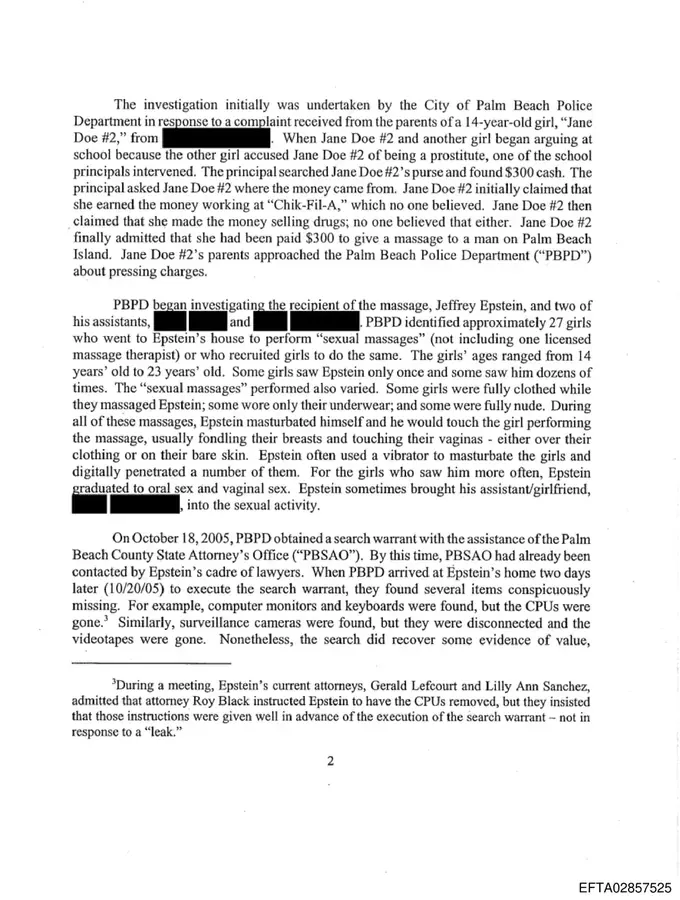
The Palm Beach Police Department had identified approximately 27 girls and women between the ages of 14 and 23 who went to Epstein's house for 'sexual massages' [3]. Girls were recruited from a local high school. The memo documented the October 2005 search warrant execution at Epstein's Palm Beach home, which found computer monitors without CPUs, surveillance cameras that were disconnected, and videotapes that were gone. Epstein's own attorneys later admitted that attorney Roy Black had 'instructed Epstein to have the CPUs removed' [3].
A federal prosecutor asked permission to arrest Jeffrey Epstein on 60 counts in May 2007. By September, the indictment was dead. In its place: the non-prosecution agreement that let a sex trafficker plead to a state prostitution charge and serve 13 months in a county jail with work release. This 205-page memo is the before picture.
 View source document
"Epstein is considered an extremely high flight risk and, from information we have received, a continued danger to the community based upon his continued enticement of underage girls. For these reasons, we would like to present a sealed indictment to the Grand Jury on May 15, 2007." — Operation Leap Year Prosecution Memorandum, May 1, 2007 [3]
Four Versions of a Case That Kept Evolving
The backfill contained four separate versions of the prosecution memo, spanning ten months of revisions. The progression documents how the government's case evolved from the initial push for arrest to the final attempt to salvage a prosecution that was slipping away.
EFTA02857810 is a 30-page memorandum dated April 23, 2007 — eight days before the main 205-page version [6]. It appears to be an earlier draft laying out the legal framework for charging Epstein under 18 U.S.C. § 2423(b) for interstate transportation of minors for sexual purposes. It documents specific victim accounts — Jane Doe #2 transported to 358 El Brillo Way, Palm Beach, for $300 — and references both Trump and Clinton in the context of the Epstein case [6].
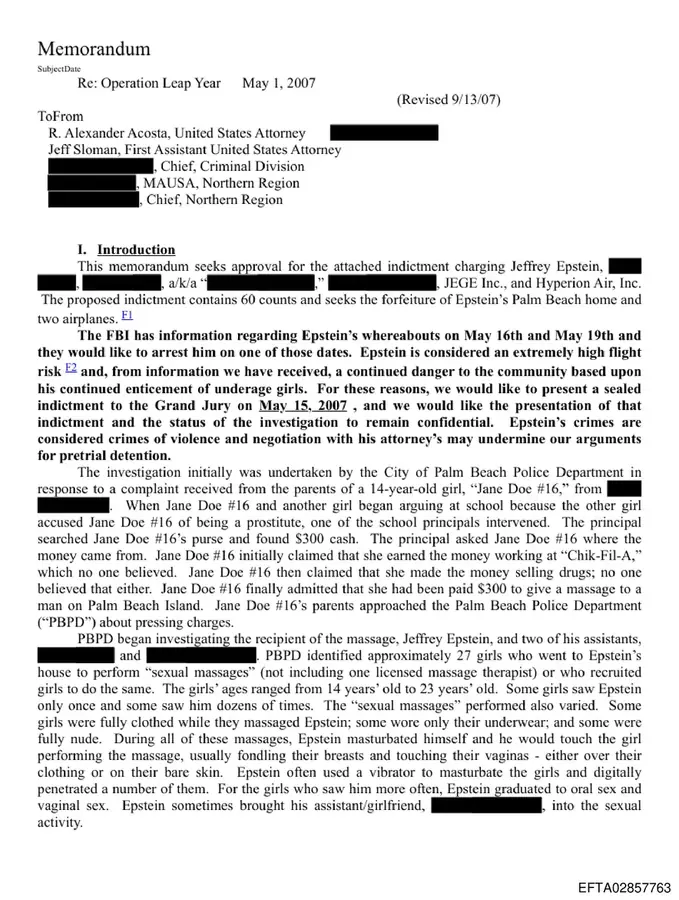
EFTA02857763 is a 47-page legal memorandum revised September 13, 2007 [5]. By this point, the indictment had not been filed. The memo lays out interstate sex-trafficking arguments under the Mann Act, documenting how Epstein traveled between states with victims aged 14-16, and establishes the 'commercial sex act' definition under federal law [5]. It confirms victims were recruited from a Palm Beach high school and transported across state lines — the same facts that would later form the basis of the 2019 SDNY indictment [5].
EFTA02857732 is a 31-page version revised both September 13, 2007 and February 19, 2008 — five months after the non-prosecution agreement was signed [4]. This is the most striking revision: prosecutors were still updating their case memo months after the deal was done. The memo details payment structures ($200 for 20 minutes, $100 for 15 minutes), identifies an unnamed 'assistant' who coordinated sexual activities with minors, and expands the victim list to Jane Does 8 through 18 [4].
Together, these four memos total 313 pages of internal DOJ deliberation. ABC News first reported on the prosecution memo in January 2026, calling it 'revealed for the 1st time' [13]. But the four versions backfilled into Dataset 12 on March 5 show not just the case that was built — they show the case that kept being revised even after it was abandoned.
 View source document
The Immunity Memo: Trying to Flip Lesley Groff
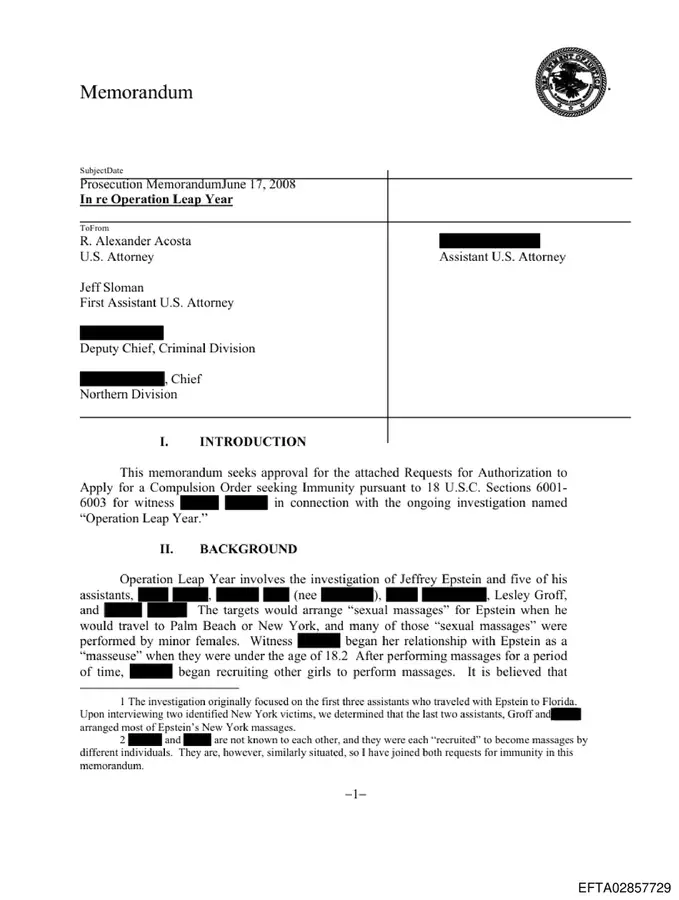
EFTA02857729 is a 3-page prosecution memorandum dated June 17, 2008 — more than a year after the original 60-count indictment was drafted and nine months after the non-prosecution agreement was signed [7]. Titled 'Prosecution Memorandum' with the subject line 'In re Operation Leap Year,' it is addressed to U.S. Attorney Acosta and First Assistant Jeff Sloman [7].
The memo seeks approval to apply for immunity and compulsion orders for witnesses pursuant to 18 U.S.C. Sections 6001-6003 [7]. It identifies the investigation as targeting 'Jeffrey Epstein and five of his assistants' — naming Lesley Groff alongside four other redacted individuals [7]. The targets 'would arrange "sexual massages" for Epstein when he would travel to Palm Beach or New York, and many of those "sexual massages" were performed by minor females' [7].
The prosecutorial strategy is explicit: the memo argues that 'the best way to strengthen our case at this point is to "flip" one of the assistants, and Groff is the most likely to flip if we have sufficient evidence to charge her' [7]. One witness began her 'relationship' with Epstein as a 'masseuse' when she was under 18 and, after performing massages for a period of time, 'began recruiting other girls to perform massages' [7].
This memo was written while the non-prosecution agreement was being finalized — meaning prosecutors were still actively building a case even as the deal that would end it was being negotiated. Two victims had reported that Epstein 'was with FBI agents during alleged sexual misconduct events,' directly implicating FBI presence in incidents tied to the case [7]. The memo acknowledges the prosecutor was 'reluctant to proceed' with full immunity because doing so would require letting the witness testify about 'what happened between her and Epstein' without the ability to prosecute [7].
 View source document
582 Pages: The FBI Rebuilds the Case
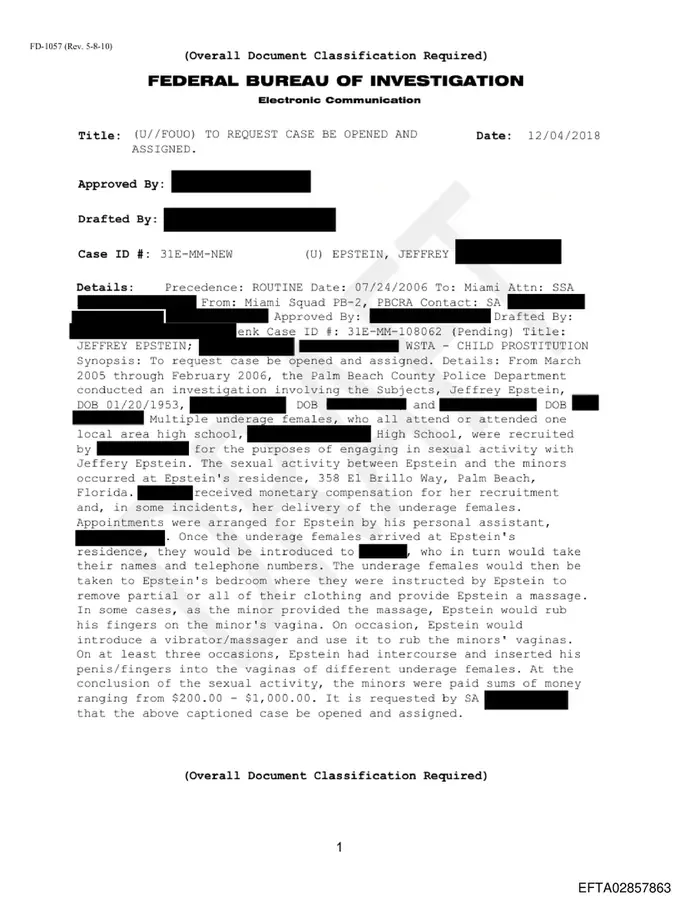
EFTA02857863 is the single largest document among the 20 backfilled files — a 582-page FBI Electronic Communication dated December 4, 2018 [8]. Titled 'TO REQUEST CASE BE OPENED AND ASSIGNED,' Case ID 31E-MM-NEW, it is the formal document that restarted the federal investigation into Jeffrey Epstein — the investigation that led to his July 2019 arrest on sex-trafficking charges [8].
The EC reconstructs the entire Palm Beach investigation from the beginning. It identifies Epstein's address at 358 El Brillo Way, documents the recruitment pipeline from local high schools, and states that 'multiple underage females' were recruited 'for the purposes of engaging in sexual activity with Jeffery Epstein' [8]. The minors were paid '$200 to $1,000' per encounter [8]. It names Larry Visoski, David Richard, William Hammond, Bruce Gordon, Alfredo Rodriguez, and Janice Banasiak as interviewees, and details Epstein's Palm Beach and Miami residences as locations for alleged misconduct [8].
The document is significant for what it represents: eleven years after the non-prosecution agreement let Epstein walk, the FBI assembled 582 pages of evidence to justify reopening the case. The EC references case dates from September 2006 and draws on victim testimony, financial transactions, and the original PBPD investigation to build the foundation for what became the SDNY prosecution [8].
The government's own 582-page file shows that the FBI had to rebuild from scratch the case that the DOJ had already built — and abandoned — in 2007. Both the original case and the reconstruction were withheld from the initial public release.
 View source document
Document Timeline
FBI opens Operation Leap Year investigation into Jeffrey Epstein
[3]Earliest backfilled prosecution memo drafted (EFTA02857810, 30 pages)
[6]205-page prosecution memo sent to Acosta seeking 60-count indictment and Epstein's arrest within two weeks (EFTA02857524)
[3]Epstein signs the non-prosecution agreement — the indictment is dead
[14]Prosecution memo EFTA02857732 revised again — five months after the NPA was signed
[4]Immunity memo seeks to compel testimony from Lesley Groff and flip Epstein's assistants (EFTA02857729)
[7]FBI files 582-page Electronic Communication requesting the Epstein case be reopened (EFTA02857863)
[8]Jeffrey Epstein arrested on federal sex-trafficking charges by SDNY
[15]DOJ releases Dataset 12 with 152 manifested documents. These 16 files are not among them.
[1]DOJ backfills 20 files into Dataset 12 outside the original manifest, including all prosecution memos and the case-opening EC
[16]The Peter Nygard Crossover: A Parallel Investigation
Among the 16 non-Trump backfilled documents is one that connects the Epstein investigation to another sex-trafficking prosecution entirely.
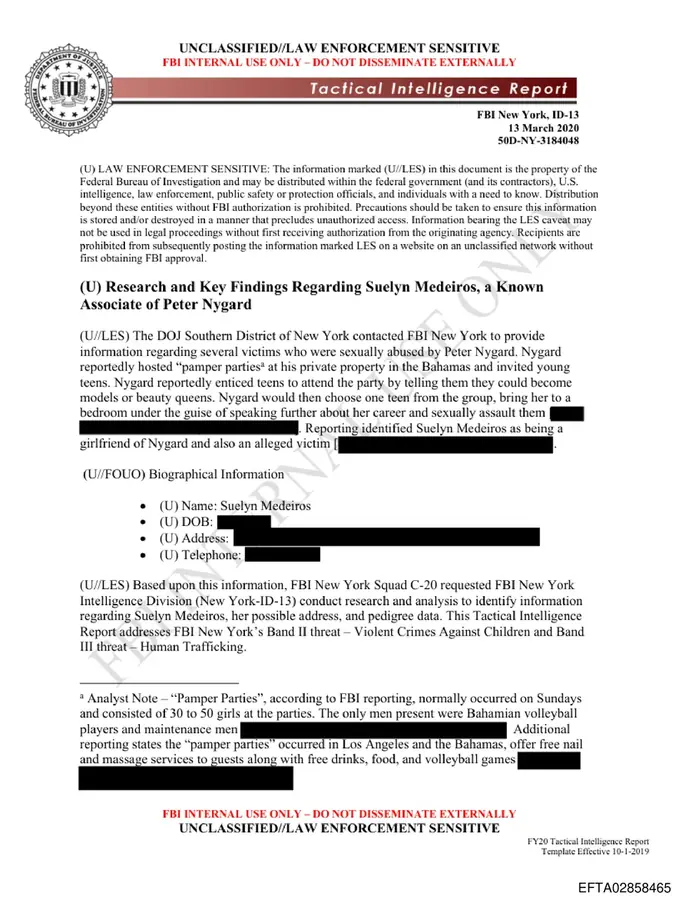
EFTA02858465 is a 16-page FBI Tactical Intelligence Report dated March 13, 2020, produced by FBI New York, ID-13, under case number 50D-NY-3184048 [12]. The report is classified 'UNCLASSIFIED//LAW ENFORCEMENT SENSITIVE — FBI INTERNAL USE ONLY' and is titled 'Research and Key Findings Regarding Suelyn Medeiros, a Known Associate of Peter Nygard' [12].
The report documents how the DOJ Southern District of New York 'contacted FBI New York to provide information regarding several victims who were sexually abused by Peter Nygard' [12]. Nygard — the Canadian fashion executive later charged by the SDNY with racketeering, sex trafficking, and related crimes in December 2020 — reportedly hosted 'pamper parties' at his Bahamas estate where he 'invited young teens' and 'enticed teens to attend the party by telling them they could become models or beauty queens' [12]. The report classifies the investigation under 'Band II threat — Violent Crimes Against Children and Band III threat — Human Trafficking' [12].
The analyst's footnote is specific: 'Pamper Parties,' according to FBI reporting, 'normally occurred on Sundays and consisted of 30 to 50 girls at the parties. The only men present were Bahamian volleyball players and maintenance men' [12]. The report documents extensive travel records for Medeiros linking Los Angeles, Toronto, and Sao Paulo between 2013-2014, and identifies investigative gaps regarding potential victim recruitment [12].
This FBI tactical intelligence report was produced by the same SDNY office that prosecuted Epstein's 2019 case. It was filed in Dataset 12 — the Epstein dataset — and then withheld from the initial release. Its presence in the backfill suggests the government recognized a connection between the two trafficking networks worth documenting in the Epstein file.
 View source document
The Victims Who Were Also Delayed
The prosecution memos and institutional records are the most historically significant backfilled files. But the package also includes victim testimony that was withheld alongside them.
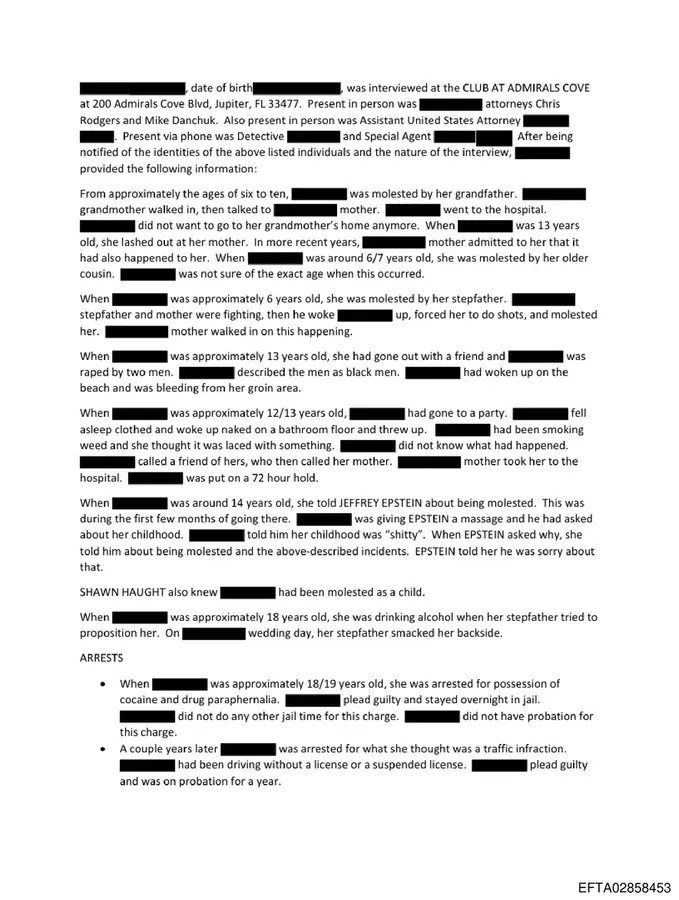
EFTA02858453 is an 8-page victim interview from the Palm Beach investigation documenting a woman who began visiting Epstein at approximately age 14 [10]. She described escalating abuse including being undressed during massages while Epstein masturbated, interactions with Ghislaine Maxwell, and being directed to massage an unidentified 'chunky and bald' man who then sexually assaulted her [10]. The interview was conducted at the Club at Admirals Cove in Jupiter, Florida, with attorneys Chris Rodgers and Mike Danchuk present, and an Assistant United States Attorney on the line [10]. The document records a childhood of prior abuse — molestation by a grandfather starting at age six, assault by a stepfather — before describing how, 'when she was around 14 years old, she told JEFFREY EPSTEIN about being molested' while giving him a massage [10].
EFTA02858445 is an 8-page FBI FD-302 from August 2019 documenting an interview with a young woman recruited through the modeling industry at age 16 [17]. The document is almost entirely redacted — only FBI headers and date stamps are visible — making it one of the most heavily redacted files in the entire backfill [17].
EFTA02858461 contains testimony from Janusz Banasiak, Epstein's longtime household employee in Palm Beach, describing the household operations, message-taking procedures, and his interactions with individuals identified only as 'GM' and 'J' [11].
Six additional victim interviews — EFTA02857840, EFTA02857844, EFTA02857845, EFTA02857849, EFTA02857857, and EFTA02857860 — also appear among the backfilled files [9]. Each is a substantive investigative record — added to the Dataset 12 IMAGES directory outside the original OPT production manifest.
 View source document
What the DOJ Has Said
The DOJ has offered two explanations for the delayed files. On March 6, 2026, the department stated that the interview summaries were initially withheld because they were 'mistakenly marked as duplicative,' acknowledging that 'we reviewed the entire batch with the similar coding and discovered 15 documents were incorrectly coded as duplicative' [16]. Separately, five prosecution memos were initially withheld as 'privileged' and were partially released 'while still protecting the privileged materials' [16].
The 'duplicative' coding explanation accounts for the victim interviews and the FBI case-opening EC. The 'privileged' explanation accounts for the prosecution memos. Together they cover the full set of withheld files. But neither explanation addresses the central question: why were these specific records — the ones documenting the government's most consequential decisions about Epstein — the ones that were miscoded or withheld as privileged, while 152 other documents in the same dataset were processed correctly?
Rep. Robert Garcia (D-Calif.) said there was 'definitely... evidence of a cover up happening' after viewing unredacted materials at DOJ [18]. He announced plans for Congressional subpoenas of Attorney General Pam Bondi regarding the handling of the files [18].
This article does not establish that the staggered release was intentional. Processing errors in a 3.5-million-page release are plausible, and the DOJ's acknowledgment of miscoding is a more specific explanation than earlier blanket denials. But the pattern remains specific: the documents that were delayed include the full prosecutorial history of the case — from the 60-count indictment that was never filed to the immunity memo that tried to salvage it to the 582-page file that restarted it. That pattern is now documented.
The 16 Non-Trump Backfilled Documents
Document | Type | Date | Pages | Content |
|---|---|---|---|---|
EFTA02857524 | Prosecution Memo | May 1, 2007 | 205 | 60-count indictment request; seeks Epstein's arrest |
EFTA02857810 | Prosecution Memo | April 23, 2007 | 30 | Earlier draft; legal framework for federal charges |
EFTA02857763 | Legal Memo | May 1 / Sept 13, 2007 | 47 | Interstate sex-trafficking arguments under Mann Act |
EFTA02857732 | Prosecution Memo | Sept 2007 / Feb 2008 | 31 | Revised after NPA; expands victim list to Jane Does 8-18 |
EFTA02857729 | Immunity Memo | June 17, 2008 | 3 | Seeks to compel testimony; targets Lesley Groff |
EFTA02857863 | FBI EC | December 4, 2018 | 582 | Case-opening request to restart Epstein investigation |
EFTA02858453 | Victim Interview | Palm Beach era | 8 | Victim from age 14; describes escalating abuse and Maxwell |
EFTA02858445 | FBI FD-302 | August 2019 | 8 | Almost entirely redacted modeling industry victim interview |
EFTA02858461 | Staff Testimony | Unknown | 4 | Janusz Banasiak; Epstein household operations |
EFTA02858465 | FBI Intel Report | March 13, 2020 | 16 | Peter Nygard crossover; 'pamper parties' investigation |
EFTA02857840 | Victim Interview | Various | — | Additional Palm Beach / 2019 victim record |
EFTA02857844 | Victim Interview | Various | — | Additional Palm Beach / 2019 victim record |
EFTA02857845 | Victim Interview | Various | — | Additional Palm Beach / 2019 victim record |
EFTA02857849 | Victim Interview | Various | — | Additional Palm Beach / 2019 victim record |
EFTA02857857 | Victim Interview | Various | — | Additional Palm Beach / 2019 victim record |
EFTA02857860 | Victim Interview | Various | — | Additional Palm Beach / 2019 victim record |
What This Means for the Record
The Dataset 12 backfill has dominated headlines for the Trump-linked FBI interviews it contained. That coverage is warranted — those are significant documents. But the fixation on the political dimension has obscured what may be the more historically important finding: the DOJ initially withheld the foundational prosecutorial record of the Epstein case itself.
The four prosecution memos document the case the government built to imprison Epstein in 2007. The immunity memo documents the last attempt to salvage that prosecution by flipping his assistant Lesley Groff. The 582-page FBI EC documents the government's decision to try again in 2018. The victim interviews document what happened to the people the government failed in between. And the Peter Nygard tactical intelligence report documents a parallel trafficking network that the same federal office was investigating.
These files are internal government records produced by federal prosecutors and FBI agents over a 13-year span. They document institutional decisions, legal strategies, and investigative findings — the kind of records that the Epstein Files Transparency Act was specifically designed to make public.
They were withheld from the initial release. They are public now. Read them.
Frequently Asked Questions
- What was the 60-count Epstein indictment that was never filed?
- In May 2007, a federal prosecutor sent U.S. Attorney Alexander Acosta a 205-page memo seeking a 60-count indictment against Jeffrey Epstein and his arrest within two weeks. The memo documented 27 victims aged 14-23 recruited from a local high school. The indictment was abandoned in favor of a non-prosecution agreement that let Epstein plead to a state prostitution charge.
- How many Epstein prosecution documents were withheld from the DOJ release?
- Sixteen non-Trump files totaling over 900 pages were backfilled into Dataset 12 on March 5, 2026 -- 35 days after the mandated January 30 release. They include four prosecution memos (313 pages), an immunity memo targeting Lesley Groff, and the 582-page FBI file that restarted the investigation in 2018.
- Who was Lesley Groff in the Epstein case?
- Lesley Groff was Epstein's longtime assistant. A June 2008 immunity memo reveals prosecutors tried to 'flip' Groff by compelling testimony, calling her 'the most likely to flip if we have sufficient evidence to charge her.' The memo was written while the non-prosecution agreement was being finalized.
- What is the Peter Nygard connection to the Epstein investigation?
- A 16-page FBI tactical intelligence report from March 2020, produced by the same SDNY office that prosecuted Epstein, was filed in the Epstein dataset. It documents Peter Nygard's 'pamper parties' hosting 30-50 girls at his Bahamas estate and identifies links between the two trafficking networks.
- Why did the DOJ say the Epstein prosecution memos were withheld?
- The DOJ stated that 15 documents were 'incorrectly coded as duplicative' and five prosecution memos were initially withheld as 'privileged.' The department released them after investigative reporting flagged their absence from the original mandated release.