'She Was Forced to Perform Oral Sex on President Trump.' The FBI Records DOJ Took Five Weeks to Release.
Four FBI interview records documenting detailed abuse allegations against Donald Trump were absent from the January 30 release and surfaced only in a March 5 backfill. The delayed files were part of a 20-document Volume 12 addendum that also included Operation Leap Year prosecution memos seeking Epstein's arrest and a 582-page FBI case-opening file. The pattern raises a question the DOJ still has not answered: why were these records delayed?
 View source document
What the Documents Show
On March 5, 2026, the Department of Justice quietly added new files to its Epstein public database — including four FBI records that document, in the government's own words, detailed allegations that Donald Trump sexually assaulted a minor in the company of Jeffrey Epstein [1][2][3][4]. The records had been absent from the January 30, 2026 mass release of 3.5 million pages mandated by the Epstein Files Transparency Act [5]. Their appearance five weeks later, in a separate wave, raises a documented question: why were these specific records delayed?
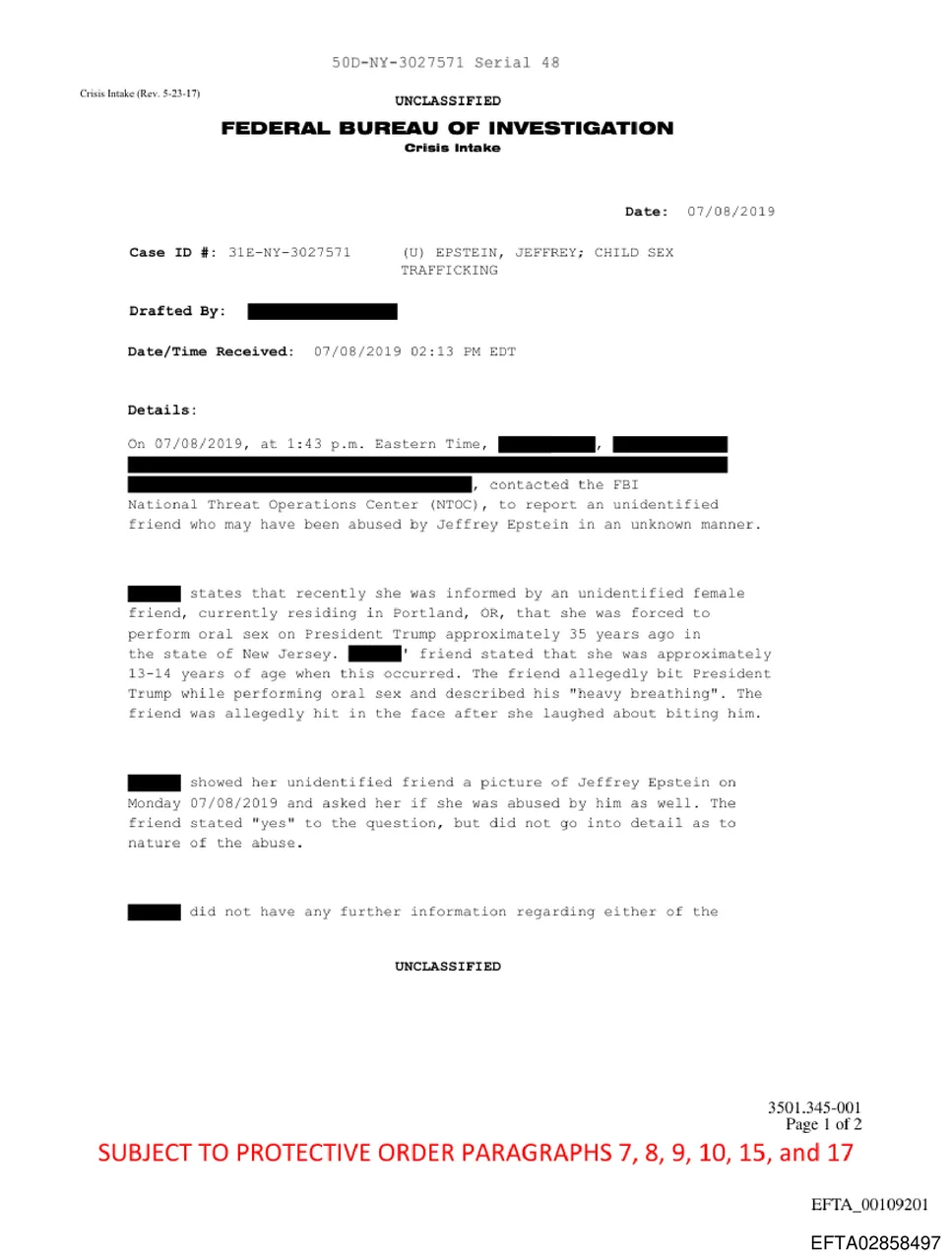
The four files belong to FBI Case 31E-NY-3027571 — the federal child sex trafficking investigation into Jeffrey Epstein opened in July 2019 [1]. They document a protected source, identified only by a redacted name, across four separate FBI contacts between July and October 2019: a Crisis Intake report (Serial 48), and three FD-302 interview summaries (Serials 252, 264, and 312) [1][2][3][4]. Collectively, they total 18 pages of FBI records that were not in the original Dataset 12 production manifest.
The FBI conducted at least four interviews with this woman over three months. She alleged Trump forced her to perform oral sex when she was approximately 13 years old, in either New York or New Jersey, while in the company of Jeffrey Epstein. She described being struck when she resisted. And the FBI kept interviewing her. [2][3]
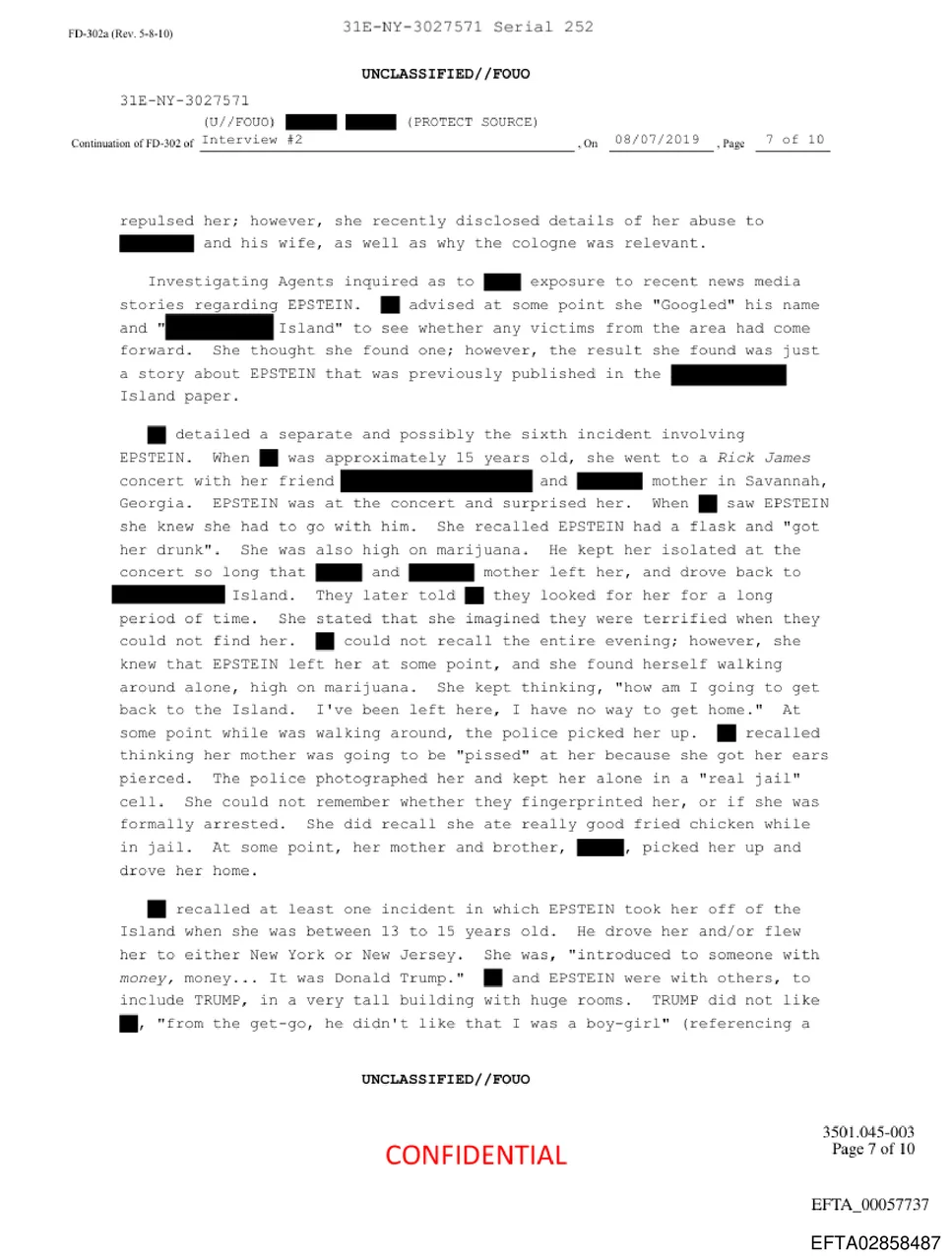
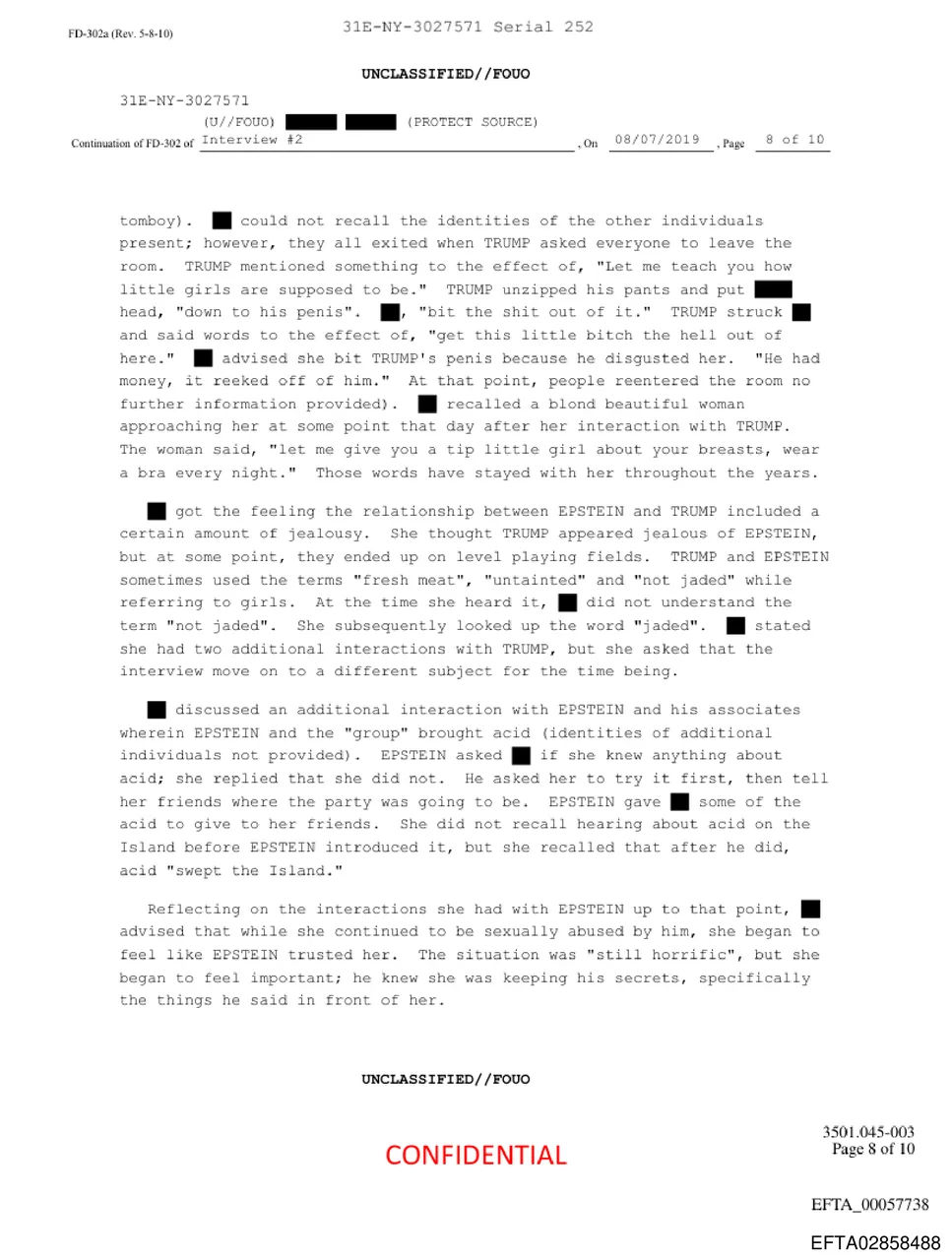
"TRUMP mentioned something to the effect of, 'Let me teach you how little girls are supposed to be.' TRUMP unzipped his pants and put [her] head, 'down to his penis'. [She], 'bit the shit out of it.' TRUMP struck [her] and said words to the effect of, 'get this little bitch the hell out of here.'" — FBI FD-302, Interview #2, Serial 252, August 7, 2019 [2]
The Interview Trail: July to October 2019
The document trail begins on July 8, 2019 — two days after Epstein's arrest on federal sex trafficking charges. A woman contacted the FBI's National Threat Operations Center (NTOC) to report that an unidentified friend, residing in Portland, Oregon, had told her she was 'forced to perform oral sex on President Trump approximately 35 years ago in the state of New Jersey' [1]. The friend stated she was approximately 13-14 years old at the time. According to the Crisis Intake form, the friend also confirmed she had been abused by Epstein when shown his photograph [1].
By August 7, 2019, the FBI had located the woman herself and conducted a second, extensive interview — Interview #2, Serial 252 — spanning 10 pages [2]. In this interview, the protected source provided detailed accounts of repeated sexual abuse by Epstein beginning when she was approximately 13 years old. She described being taken off an island by Epstein to either New York or New Jersey, where she was 'introduced to someone with money, money... It was Donald Trump' [2]. She recounted Trump asking everyone to leave the room, then sexually assaulting her. She stated she bit Trump's penis, after which he struck her and ordered her removed [2].
The source also told the FBI that Trump and Epstein 'sometimes used the terms "fresh meat," "untainted" and "not jaded" while referring to girls' [2]. She said she had 'two additional interactions with TRUMP' beyond the one she detailed, but asked to move on to a different subject [2].
 View source document
 View source document
Interview #3: Threats, Intimidation, and 'The Other One'
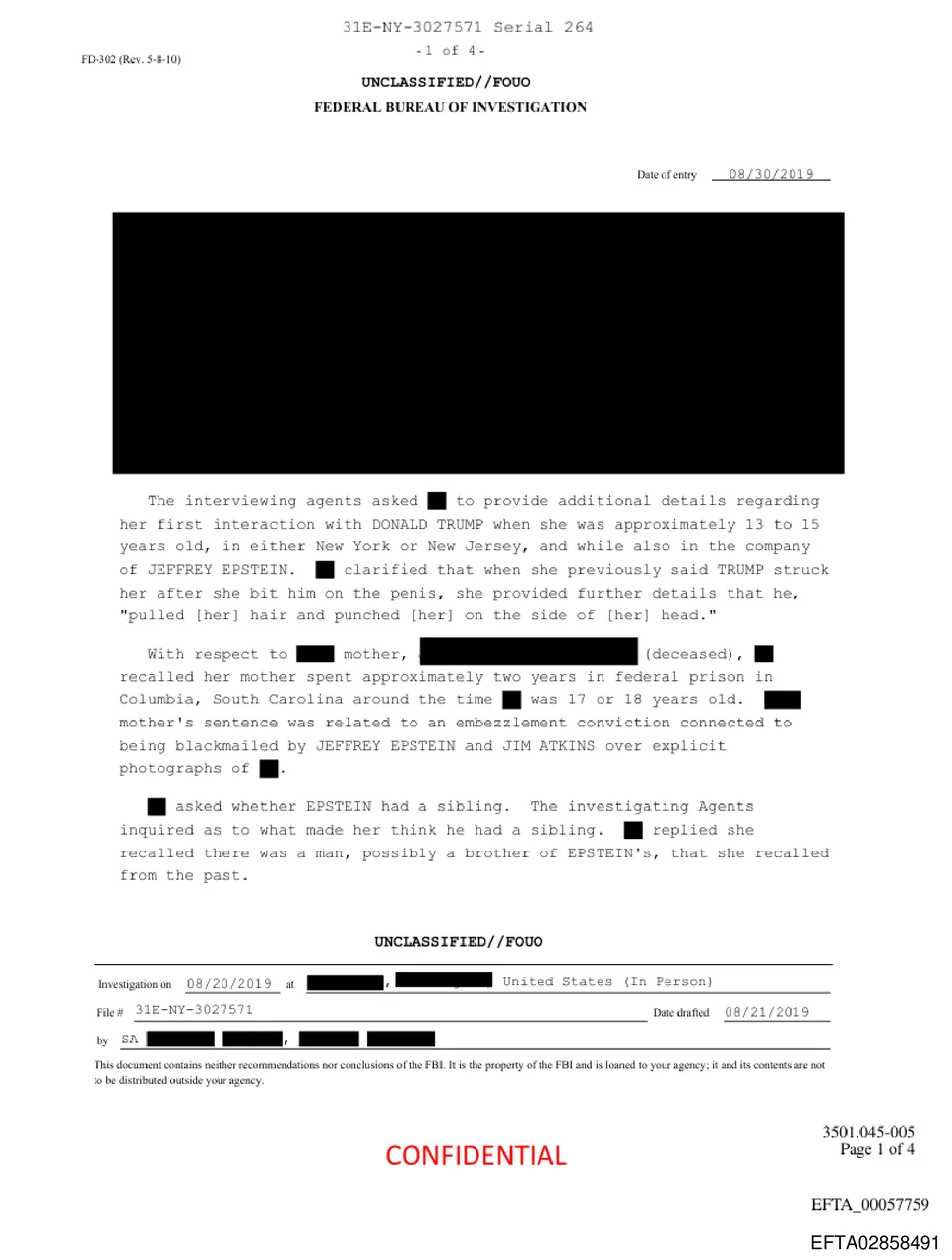
On August 20, 2019, the FBI conducted a third interview (Serial 264) [3]. In this session, the source provided additional details about the Trump assault, clarifying that when she 'previously said TRUMP struck her after she bit him on the penis, she provided further details that he, "pulled [her] hair and punched [her] on the side of [her] head"' [3].
The source also described decades of threatening phone calls she attributed to Epstein's associates. She recounted calls with messages like 'Fuck you. You better keep your mouth shut' and 'we know where you're at, you need to keep your mouth shut' [3]. She described four to five incidents where she was nearly run off the road, including one in which two vehicles attempted to force her car into an 18-wheeler on Interstate 5 [3].
When asked who she believed was behind the threats, the source identified both Epstein and Trump. She stated under her breath that 'if it was not EPSTEIN, maybe it was the "other one".' When asked who the 'other one' was, she replied: 'Trump' [3]. An administrative note in the FBI document records that immediately after declining to elaborate, the source looked at her attorney and stated, 'when he was running...' — to which her attorney responded, '...more tracks to cover' [3]. The source repeated the statement back.
 View source document
Interview #4: The Source Asks 'What's the Point?'
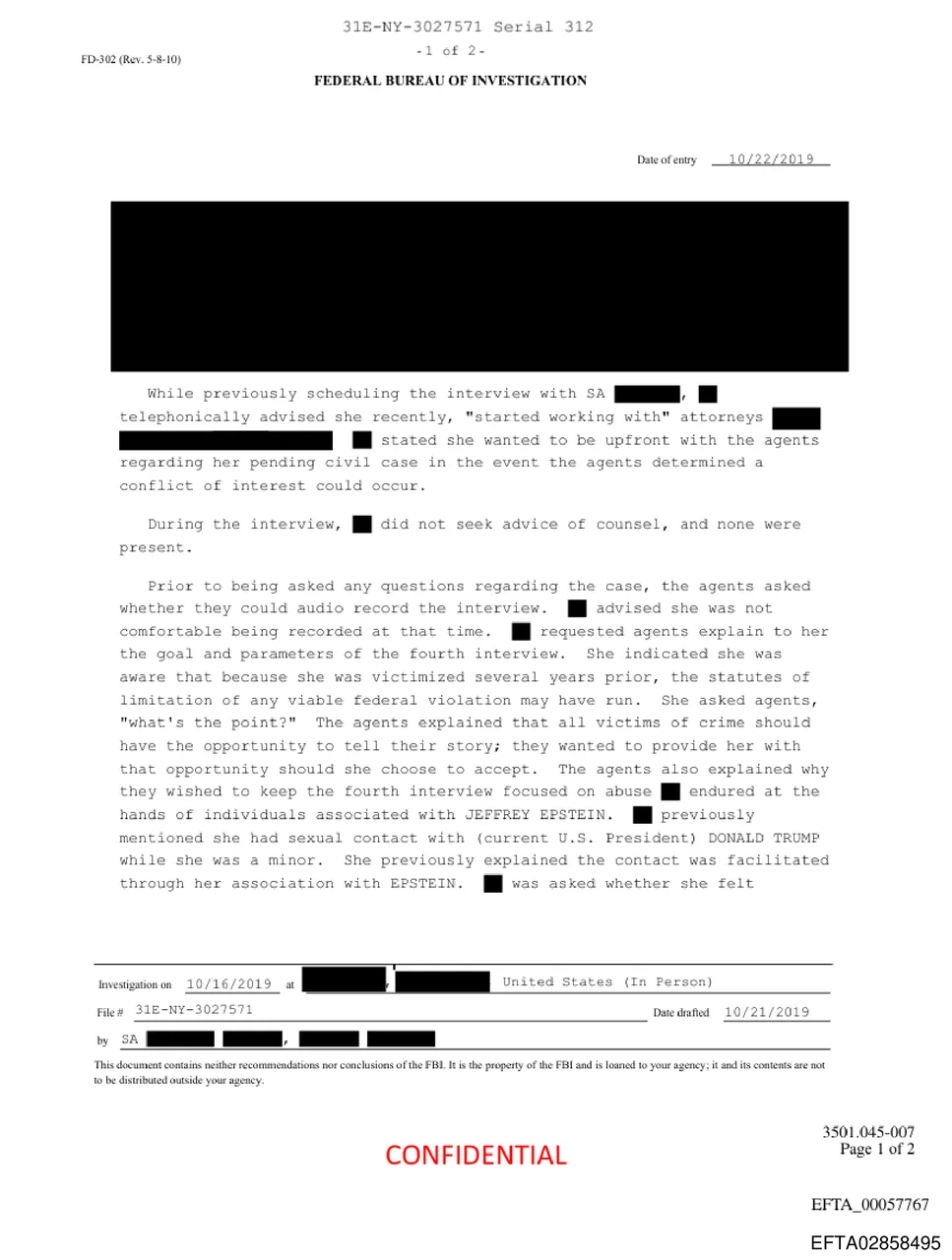
The fourth interview, conducted October 16, 2019 (Serial 312), is the shortest — two pages [4]. By this point, the source had retained civil attorneys and asked the FBI agents to explain 'the goal and parameters of the fourth interview' [4]. She noted she was aware that 'the statutes of limitation of any viable federal violation may have run' and asked agents, 'what's the point?' [4].
The FBI agents explained 'that all victims of crime should have the opportunity to tell their story' and asked whether she was comfortable detailing her contacts with Trump [4]. The source again asked what the point would be 'when there was a strong possibility nothing could be done about it' [4]. The agents asked her to go home and think about speaking further. She agreed, and the interview ended [4].
The FBI interviewed this woman four times in three months. She described being sexually assaulted by the current President of the United States when she was 13 years old. She described decades of threats. And these interview records were not included in the initial public release mandated by law.
 View source document
Twenty files were added to the DOJ's Dataset 12 outside the original production manifest. Four of those files document a protected FBI source's detailed allegations that President Trump sexually assaulted her at age 13. They appeared in the public database five weeks after the legally mandated release date. The DOJ has called this a processing error. The pattern does not prove intent — but it is now documentable.
The Backfill Pattern: 20 Files Outside the Manifest
The Epstein File Ranker's analysis of Dataset 12 (VOL00012) reveals a structural anomaly in the DOJ's release. The original production manifest — the OPT file that indexes every document in the volume — lists 152 unique documents spanning 1,525 pages [6]. But the actual IMAGES directory for Volume 12 contains 172 PDF files — 20 more than the manifest accounts for [6].
All 20 of the unmanifested files carry EFTA identifiers in the 02857xxx–02858xxx range, far above the manifested files which begin at EFTA02730265 [6]. In the ranked contribution output, those same 20 PDFs appear as 25 processed entries because the two largest backfilled documents were split into multiple parts for analysis [6]. The four Trump-linked FBI interview records — EFTA02858497, EFTA02858491, EFTA02858495, and EFTA02858481 — are among these 20 backfilled documents [1][2][3][4].
The remaining 16 backfilled files do not consist only of ancillary victim interviews. They also include the Operation Leap Year prosecution memoranda seeking a 60-count indictment against Epstein [14][15][16][17], the June 2008 immunity memo targeting Lesley Groff [18], the 582-page FBI case-opening request that restarted the federal investigation in 2018 [19], additional victim interviews from both the Palm Beach and 2019 New York investigations [7][8], and Epstein household staff testimony [9]. These are substantive investigative records, not administrative duplicates.
NPR first reported on February 24, 2026, that approximately 53 pages of FBI interview documents appeared to be missing from the public database — specifically three FD-302 interview summaries and accompanying notes from this protected source [10]. The DOJ initially said withheld documents were 'privileged, are duplicates or relate to an ongoing federal investigation' [11]. After the reporting, the department said it was reviewing whether records had been 'mistakenly tagged as duplicates' [11].
Document Timeline
President Trump signs the Epstein Files Transparency Act into law
[5]Initial release deadline — DOJ publishes first datasets (1-8) but draws bipartisan criticism for extensive redactions
[5]DOJ temporarily removes and then republishes certain files, including an interview with a second Trump accuser, citing a victim's request for 'additional review'
[10]NPR reports ~53 pages of FBI interviews are missing from the database, including three FD-302 summaries from the protected source who accused Trump
[10]Washington Post reports DOJ is 'reviewing if Epstein files with Trump allegations were wrongly withheld'
[12]What the DOJ Has Said — and What Remains Unanswered
The DOJ has offered two explanations. First, a spokesperson stated that withheld documents fell into specific categories: 'duplicates, privileged, part of an ongoing federal investigation' [11]. Second, after NPR's reporting, the department acknowledged that 'mistakes are inevitable' in a project involving millions of documents and that 'when flagged by the public, we immediately work to correct any errors' [11].
Rep. Robert Garcia (D-Calif.), the top Democrat on the House Oversight Committee, said there was 'definitely... evidence of a cover up happening' after viewing unredacted materials at DOJ [13]. He announced plans for Congressional subpoenas of Attorney General Pam Bondi regarding the handling of the files [13]. The White House responded through spokeswoman Abigail Jackson that Trump 'has done more for Epstein's victims than anyone before him' [10].
As of this reporting, NPR's accounting shows that 37 pages of records remain absent from the public database — including interview notes, a law enforcement report, and license records related to the protected source [11]. The DOJ has not explained why the four Trump-linked FBI interviews were excluded from the original Dataset 12 manifest while 152 other documents in the same volume were included on time.
This article does not establish that the staggered release was intentional. Processing errors in a 3.5-million-page release are plausible. But the pattern is specific: the documents that were delayed are the ones that contain the most detailed allegations against a sitting president. That pattern is now documented. Whether it reflects bureaucratic error or deliberate staging is a question for the DOJ and for Congress.
Key Facts
31E-NY-3027571 — EPSTEIN, JEFFREY; CHILD SEX TRAFFICKING
DOJ Dataset 12 (VOL00012)
152 (in original OPT file)
172 (20 added outside manifest)
4 files, 18 pages (Serials 48, 252, 264, 312)
January 30, 2026
March 5, 2026 (35 days later)
37 (per NPR, as of March 5, 2026)
The 60-Count Indictment That Never Was: Operation Leap Year
The Trump-linked FBI interviews are the most politically significant of the 20 backfilled files. But arguably the most historically significant are the Operation Leap Year prosecution memos — the documents that show how close the federal government came to putting Epstein behind bars in 2007, before the non-prosecution agreement that let him walk.
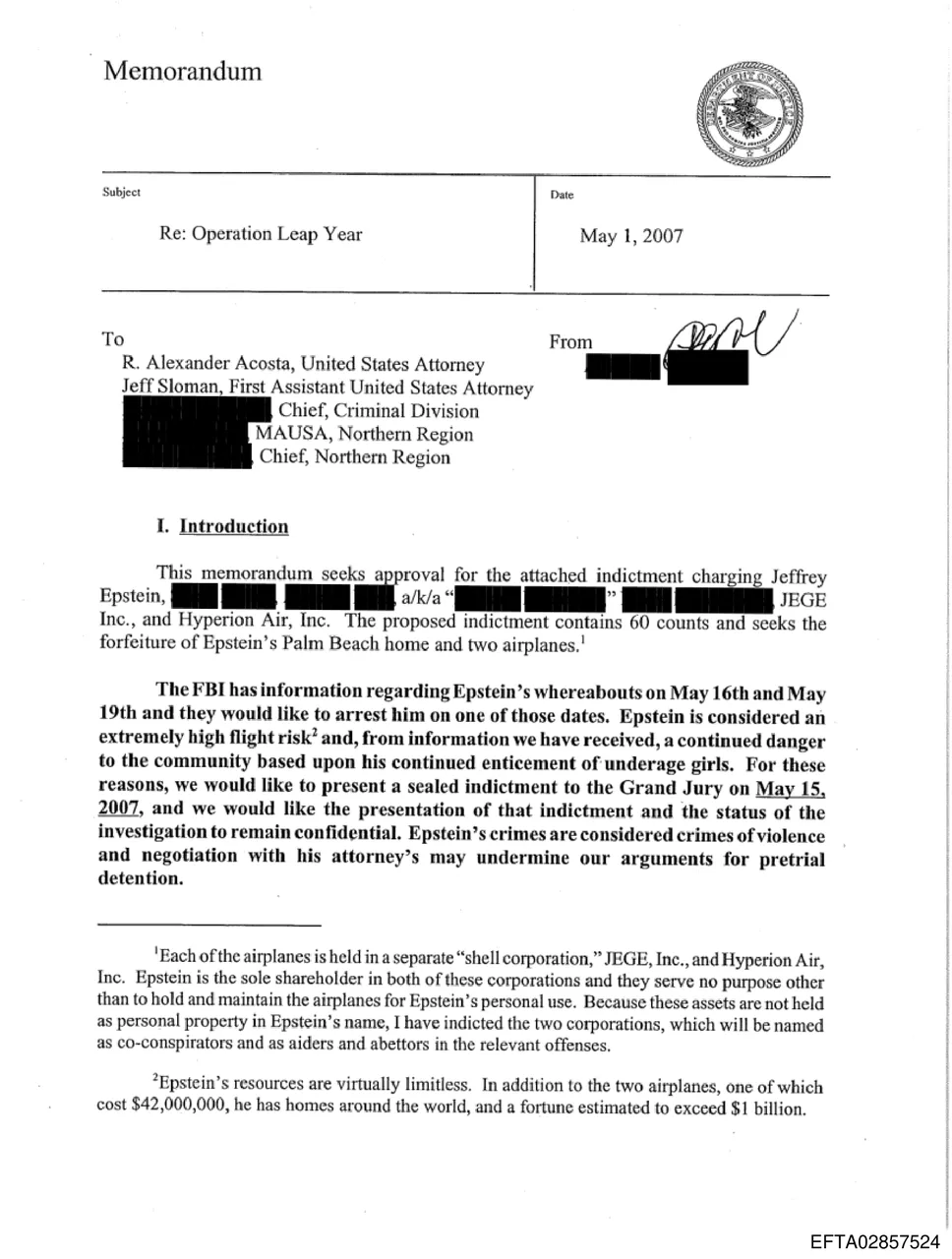
EFTA02857524 is a 205-page prosecution memorandum dated May 1, 2007, from the Southern District of Florida to U.S. Attorney R. Alexander Acosta and First Assistant Jeff Sloman [14]. The memo's opening paragraph states its purpose plainly: 'This memorandum seeks approval for the attached indictment charging Jeffrey Epstein... The proposed indictment contains 60 counts and seeks the forfeiture of Epstein's Palm Beach home and two airplanes.' The AUSA wrote in bold that the FBI had information on Epstein's whereabouts on May 16th and 19th and 'would like to arrest him on one of those dates.' Epstein was called 'an extremely high flight risk' with 'virtually limitless' resources — a fortune exceeding $1 billion, homes worldwide, and two airplanes costing $42 million held in shell corporations JEGE, Inc. and Hyperion Air, Inc. [14].
The memo sought a sealed indictment to be presented to a grand jury on May 15, 2007, and argued that 'Epstein's crimes are considered crimes of violence and negotiation with his attorney's may undermine our arguments for pretrial detention' [14]. It detailed how PBPD had identified approximately 27 girls — ages 14 to 23 — who went to Epstein's house for 'sexual massages.' Girls were recruited from a local high school. The memo documented the search warrant execution on October 20, 2005, which found computer monitors without CPUs, surveillance cameras that were disconnected, and videotapes that were gone. Epstein's own attorneys later admitted attorney Roy Black had 'instructed Epstein to have the CPUs removed' [14].
Three additional versions of this memo were also backfilled: EFTA02857732 (31 pages, revised September 13, 2007 and February 19, 2008), EFTA02857763 (47 pages, revised September 13, 2007), and EFTA02857810 (30 pages, dated April 23, 2007) [15][16][17]. Together these four prosecution memos total 313 pages of internal DOJ deliberation about indicting Epstein — the paper trail of a prosecution that was abandoned in favor of the notorious non-prosecution agreement.
This means the 20 backfilled files include both the original case the government built to imprison Epstein and the 2019 FBI interviews that documented what happened to his victims in the decades after they chose not to.
 View source document
The Immunity Memo and the FBI Case-Opening Request
Two additional backfilled documents fill in the other side of the prosecutorial collapse.
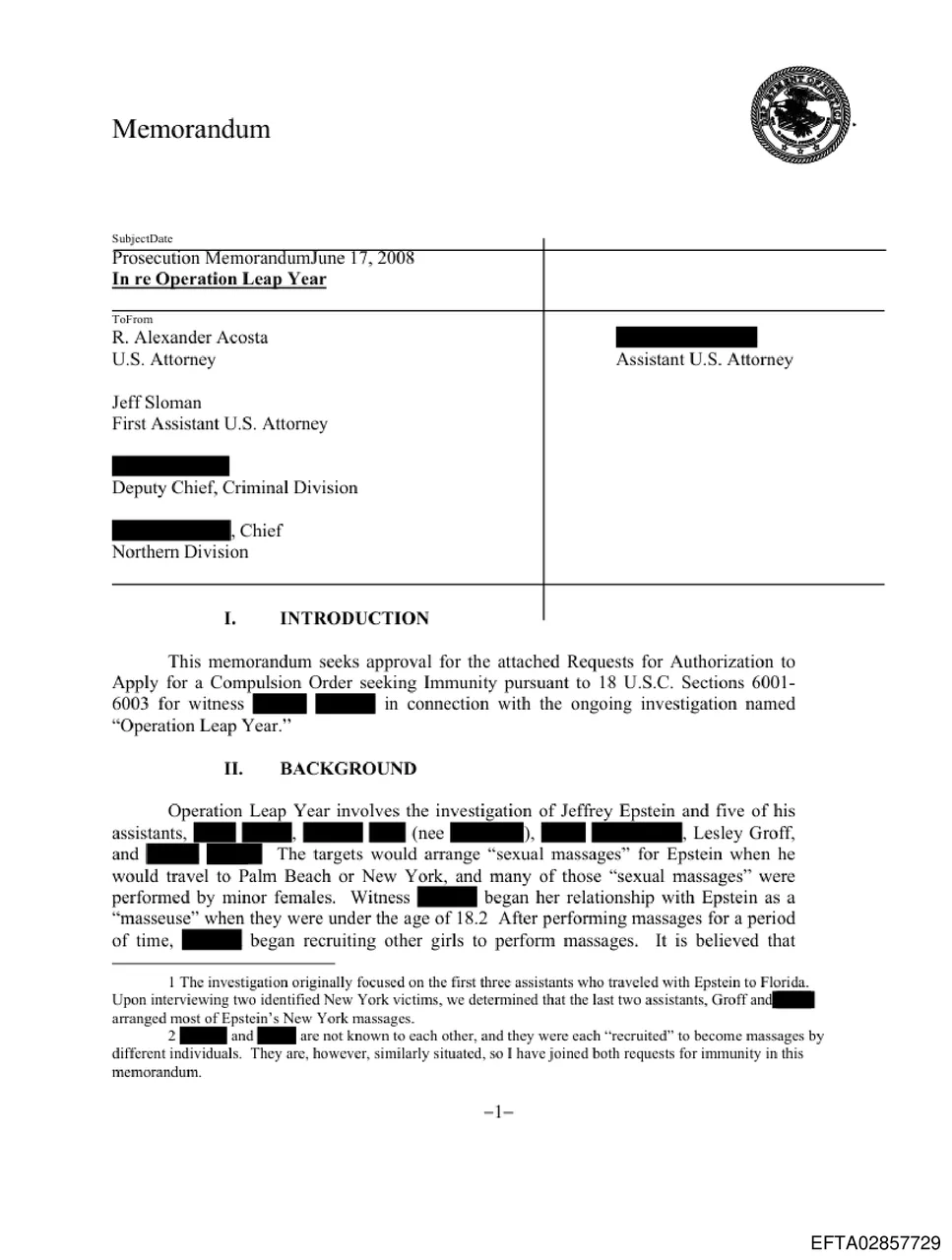
EFTA02857729 is a 3-page prosecution memorandum dated June 17, 2008 — more than a year after the original 60-count indictment was drafted — titled 'In re Operation Leap Year' and addressed to U.S. Attorney Acosta [18]. It seeks approval to apply for immunity and compulsion orders for witnesses in the Epstein investigation. The memo names Lesley Groff and five of Epstein's assistants as targets. It describes the prosecution strategy of trying to 'flip' Groff — Epstein's New York assistant — by using compelled testimony from witnesses who had been recruited as minors. The AUSA wrote that 'the best way to strengthen our case at this point is to "flip" one of the assistants, and Groff is the most likely to flip if we have sufficient evidence to charge her' [18]. This memo was written while the non-prosecution agreement was being finalized — meaning prosecutors were still actively building a case even as the deal that would end it was being negotiated.
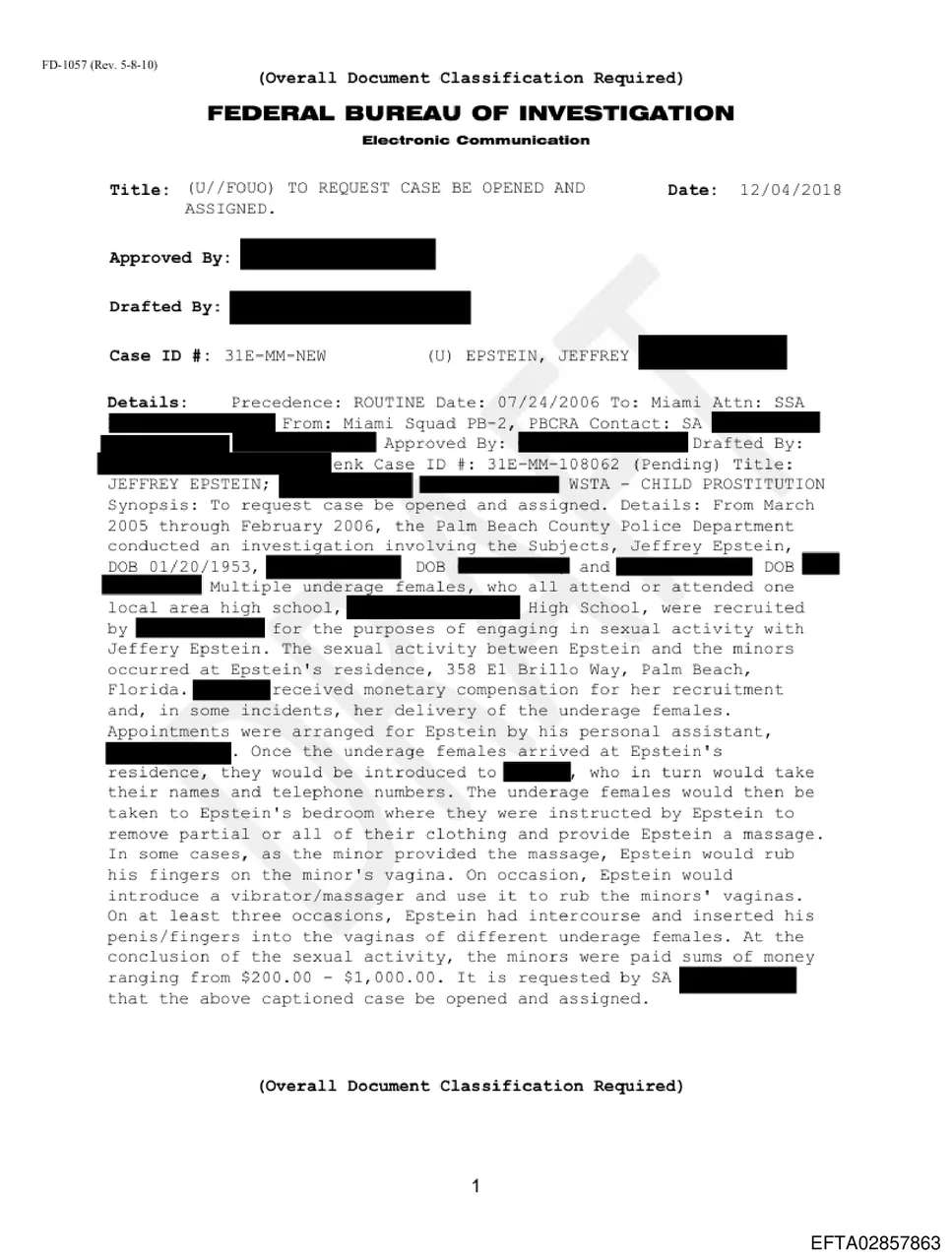
EFTA02857863 is a 582-page FBI Electronic Communication dated December 4, 2018 — the formal request to open the new federal investigation into Epstein that culminated in his July 2019 arrest [19]. Titled 'TO REQUEST CASE BE OPENED AND ASSIGNED,' Case ID 31E-MM-NEW, it details the original Palm Beach investigation, identifies Epstein's address at 358 El Brillo Way, and documents the recruitment pipeline from local high schools. It notes that 'multiple underage females' were recruited 'for the purposes of engaging in sexual activity with Jeffery Epstein' and that the minors were paid '$200 to $1,000' per encounter [19]. At 582 pages, it is the single largest document among the 20 backfilled files.
These documents are not peripheral. The prosecution memos are the internal record of the government's decision to let Epstein go. The case-opening EC is the document that restarted the investigation a decade later. Both were withheld from the initial mandated release.
 View source document
 View source document
Other Backfilled Records: Victim Interviews and Staff Testimony
The remaining backfilled files are additional victim interviews and investigative records from both the original and 2019 investigations.
EFTA02858445 is an 8-page FBI FD-302 from August 1, 2019, documenting an interview with a young woman who described being recruited into Epstein's orbit through the modeling industry at age 16 [7]. She recounted Epstein calling Halle Berry and Naomi Campbell on speakerphone to impress her, taking photographs of her in lingerie, and escalating to sexual assault. The document records Epstein telling her: 'I need to teach you how to please a man; that's what you're here for.' She described him as 'aggressive, very aggressive.' The interview was conducted at the FBI's New York office with AUSAs present [7].
EFTA02858453 is a victim interview from the Palm Beach investigation — an 8-page record documenting a woman who began visiting Epstein at approximately age 14 and described escalating abuse including being undressed during massages while Epstein masturbated, interactions with Ghislaine Maxwell, and being directed to massage an unidentified 'chunky and bald' man who then sexually assaulted her [8].
EFTA02858461 contains testimony from Janusz Banasiak, Epstein's longtime household employee in Palm Beach, who described the household manual, message-taking procedures, a search warrant execution, and stated that 'when he would arrive with the girls I would try to give them space or privacy' [9].
Six additional victim interviews (EFTA02857840, EFTA02857844, EFTA02857845, EFTA02857849, EFTA02857857, EFTA02857860) also appear among the 20 backfilled files [6]. The set additionally includes a 16-page FBI tactical intelligence report cross-referencing Peter Nygard (EFTA02858465) [20]. Every one is a substantive investigative record. None are administrative duplicates. All were added to the Dataset 12 IMAGES directory outside the original OPT production manifest.
Evidentiary Weight and Limitations
These documents are FBI records — not adjudicated findings. The allegations they contain are unverified accounts from a protected source who was interviewed but whose claims were never prosecuted. Trump has never been charged with any wrongdoing related to Epstein. The White House has called the allegations 'unfounded and false' and 'untrue and sensationalist claims...submitted to the FBI right before the 2020 election' [10].
The DOJ itself, in an earlier statement, characterized the allegations as lacking credibility [13]. Defense attorney Robert Glassman criticized the DOJ's handling of victim privacy in the broader release [10].
However, the evidentiary weight of the release pattern is separate from the evidentiary weight of the allegations inside the files. Regardless of whether the source's claims are true, the question of why these FBI records were excluded from the initial mandated release and only surfaced after investigative reporting is an accountability question that stands on its own.
The FBI interviewed this source four times over three months in 2019. The interviews were documented in official FD-302 forms and assigned serial numbers within the Epstein case file. They were subject to the Epstein Files Transparency Act. And they were not released with the other 152 documents in their dataset.
These are the government's own records. Read them.
Frequently Asked Questions
- Were Epstein files about Trump withheld from the January 2026 release?
- Yes. Four FBI interview records documenting detailed abuse allegations against Donald Trump were absent from the January 30, 2026 mass release and appeared only in a March 5 backfill -- 35 days later. The DOJ said the records were 'mistakenly marked as duplicative.'
- How many Epstein files were missing from the original DOJ release?
- Twenty files were added to Dataset 12 outside the original production manifest, which listed 152 documents. The backfilled files included four Trump-linked FBI interviews, four Operation Leap Year prosecution memos, a 582-page FBI case-opening file, victim interviews, and staff testimony. As of March 5, 2026, NPR reported 37 pages still remained absent.
- What did the FBI victim say about Trump and Epstein?
- A protected FBI source interviewed four times between July and October 2019 alleged that Trump sexually assaulted her at approximately age 13 in New York or New Jersey while in the company of Jeffrey Epstein. She stated Trump and Epstein used terms like 'fresh meat' and 'untainted' to refer to girls. These are FBI records of allegations, not adjudicated findings.
- What was Operation Leap Year in the Epstein case?
- Operation Leap Year was the FBI investigation of Jeffrey Epstein opened in May 2006. A 205-page prosecution memo from May 2007 sought a 60-count indictment and Epstein's arrest within two weeks. The indictment was never filed; instead, Epstein received a non-prosecution agreement that let him plead to a state prostitution charge.
- Did DOJ intentionally withhold Trump Epstein files?
- The DOJ called the omission a processing error, stating that documents were 'mistakenly marked as duplicative' or withheld as 'privileged.' This article does not establish that the staggered release was intentional, but the pattern is specific: the delayed documents are the ones containing the most detailed allegations against a sitting president.